Is LinkedData really more important than the Large Hadron Collider?

I’ve just read Daniel‘s recent post entitled Linked Data is more important than the Large Hadron Collider. Like Daniel I am also a passionate advocate of Linked Data and am currently working on deploying number of real world Linked Data applications along with my colleagues at Talis. Sadly though I have to confess that I found myself cringing whilst reading his piece.

Like many other scientific endeavors the Large Hadron Collider project attempts to provide scientists with huge quantities of data that might help them answer questions about the origin of the universe. As a project in it’s own right it is massive, combining the efforts of thousands of scientists from around the world.

To dismiss it, as Daniel has done, because it’s “too expensive”, or because “it wont find the cure to cancer, or HIV”, or question its relevance because “we’re still going to be here whether or not the Large Hadron Collider was successful”, is bad enough but to then use those rather specious arguments as a prop to advocate Linked Data is absolutely ridiculous.

Worse is that it overlooks the rather obvious rebuttal which is that Linked Data wont cure cancer, it wont cure HIV, and we’ll all still be here whether we have Linked Data or not :-). Even more importantly though … should anyone in our Community and by that I mean the Linked Data community really be questioning the value of any project that’s sole purpose it generate data? To then say this …

Just imagine a world where you can easily browse through the history of the atom, and then delve into the science found on the atom, and then go deeper into the subatomic level, and then browse back out into the historic realm, finding out about experiments that happened and whether it had any impact on society.

… completely misses the following point: the data to do this exists, not because of you and I Daniel, but because of the fact that since man appeared on this planet his thirst for knowledge is what has driven him forward to the point where people like you and I can sit here and say … “if you format your data like this, and give everything a dereferncible uri – that’ll be really useful!”. I’m serious … Linked Data is not a radical technology change, nor is the Semantic Web, both represent a paradigm shift, a new understanding, a new way of doing things but the fact is that the technology has been around for ages, we are only now understanding the importance of being more open, of having common vocabularies to describe things, and the importance of linking concepts together in this web of data.

The absolute last thing we want to do is to start saying to scientists, not matter how obscure ther field of research is, or how relevant we consider that research to be (personally), that it’s somehow less important than what we, as a community, are doing … because it absolutely isn’t. Are you really sure you want to be asking people to believe that answers about the origin of the universe and our existence in it are less important than an “interesting browsing experience?”

Curating the Dark Data in the long tail of science


ABSTRACT

There is a wealth of scientific data that is almost impossible to see. This is science’s dark data. Much of this data resides in the long tail of science or “small” data collection efforts. Instrumentation has made it possible to develop large collections of relatively homogeneous data, be it from space sensors or high throughput gene sequencers. The monolithic collections are easy to find and search. Dark data on the other hand may constitute the larger mass of scientific information. The collections that make up the dark data of science are much smaller but also much more numerous, being generated by thousands of scientists, on a much broader number of scientific questions, and in a complex array of formats. Unfortunately, it is also more prone to be overlooked and lost over time. Using new technology, the economics of the internet, and change in the sociology of science it is possible to make greater use of this data than was possible in the past. Data curators are the people who develop and use these technologies and procedures to make this data more useful, insuring a more efficient return on investment in the enterprise of science.

This is a really interesting tech talk given by P. Bryan Heidorn from the National Science Foundation Division of Biological Infrastructure and Associate Professor, University of Illinois.

I found the talk to be particularly useful, I’ve never come across the term Digital Curation before, and surprised to learn that it is defined as:

Digital curtaion is the acquisition, management, appraisal, and serving 
of data to maximise it's usefulness.

Curation embraces and goes beyond that of enhanced present day
re-use, and of archival responsibility, to embrace stewardship that adds
value through the provision of context and linkage: placing emphasis
on publishing data in ways that ease re-use and promoting accountability
and integration. (Rusbridge et. al, 2005)

What surprises me is that the goals of these curators are not too dissimilar to the goals of those of us working in the Linked Open Data movement, and I’m wondering whether these two communities should work more closely together … very interesting indeed.

OLPC the new XO-2 model

This video provides a quick look at the second generation OLPC, XO-2. The new system has two touch-sensitive displays. The XO-2 will be much smaller than the original machine , almost half the size! and will have a foldable e-book form factor. “The next generation laptop should be a book” according Nicholas Negropante.

The XO-2 will also have dual indoor-and-sunlight displays, which was pioneered by former OLPC CTO Mary Lou Jepsen. This new design will provide:

  • a right and left page in vertical format
  • a hinged laptop in horizontal format,
  • and a flat, two-screen continuous surface for use in tablet mode.

Younger children will be able to use simple keyboards to get going, and older children will be able to switch between keyboards customized for applications as well as for multiple languages

The have also stated that the new model will reduce power consumption down to 1 watt!

Find out more here.

Photosynth Goes Live :) but only on Windows :(

Microsoft have finally released the first public version of Photosynth, that meshes many photos of the same place together into a 3D Landscape. I have played with Photosynth in the past and have talked about it on this blog. It’s a hugely impressive technology and I can’t wait to use it in earnest. Sadly it’s only available on Windows at the moment, and sadly it wont even work on Windows running on VMWare! Hopefully they’ll launch cross platform versions of the software soon …

The Truth about Innovation – Max Mckeown

All the way back in May of this year Max sent me a preview copy of his upcoming book entitled the Truth about Innovation and asked if I’d read it and offer some feedback or write a review. I did read the book and thoroughly enjoyed it but didn’t get around to reviewing it due to a myriad of other commitments – so apologies Max :).

The other day I was watching a documentary about Pixar much of which focused on the culture of Innovation at Pixar. I immediately recalled some things that Max had written in his book, in fact many of the sentiments in the documentary were directly echoed by the observations Max had been making. Feeling somewhat abashed I re-read The Truth about Innovation over the last couple of days and think it’s about time I wrote a (pre)-review (the book is scheduled for release on September 12th according to Amazon).

The book is well written and well researched, Max makes great use of examples from industry to illustrate his fifty or so “Truths” about innovation. For me It’s a great book because it shows that innovation is about keeping our eyes and minds open, and constantly questioning what we know. Max has previously tried to sum up innovation as:

The term innovation may refer to both radical and incremental changes 
in thinking, in things, in processes or in services ...

I’ve always liked this definition, it feels practical without feeling overly idealistic. There was always a danger with this book that in presenting what he thought were his 50 truths about innovation he would fall into the trap of sounding overly idealistic or offering advice that was either vague or not particularly practical. Thankfully this is not the case. What he has written is short, sharp and extremely focused, yet tempered by an honest down to earth style that makes it not only easy to read but also easy to identify with.

Some of truths really hammered home for me because they resonated so much with what we are trying to do at Talis, not just in terms of the technologies we are building but also in terms of the culture we are trying to create and I completely agree with Max when he says in Chapter 31:

Culture is the sum total of the values, beliefs, assumptions, and traditions
of the organization. Culture is established at the time that the company is 
founded and it develops based on the experiences of the people in the 
organization. It is not the same as a neatly typed mission statement and 
cannot be transformed with half-hearted attempts or superficial 
declarations.

There are differences in character, rhythm, preferences, traditions, jokes,
discipline, and priorities between the most successfully innovative 
organizations and the rest. Turning great insights into practical solutions
is the result of what is done and the way it is done. Making the transition
to an innovation culture is difficult because it doesn’t depend on policies 
or processes in isolation.

Max also goes onto differentiate between cultures that encourage innovation and those that discourage innovation, thankfully for me Talis fits squarely in the first column but only because thats where we, as individuals, and as a group, want it to be:

Cultures that encourage innovation Cultures that discourage innovation
Emotionally connected Dispassionately disconnected
Power Sharing Power Hoarding
Visionary & Forward Thinking Tied to routine & past practise
Trusting with minimal rules Controlling and negative
Positive and highly principled Highly financially focused
People identify with leaders Remote managers issue edicts
Customer service obsessed Performance freaks
Thirst for listening and learning Excessive denial psychology
Valued people like the company Best people feel devalued
Decisions are based on merit Hierarchy slows progress

In chapter 25 Max talks about hiring people for how the learn and not what the know. This is critical in my view for any organisation and goes to the heart of innovation, but in my mind its not just about learning new things its about a passionate willingness to want to learn new things, as Tennyson says to strive, to seek, to find or as Max puts it:

Far more important than what a person knows is how the person learns.
What a person knows matters, you want experts, you want knowledge, 
but it should be taken as a given. If the person can’t do the basics then 
you shouldn’t hire them with the expectation that they can. You need 
enough people in the company who can make whatever it is that you 
are trying to sell. The way that people have learned what they know and 
the way they intend learning what they will need to know in the future is 
the difference between candidates. It’s also the difference between companies. 
Learning new things is at the heart of innovation.

I could easily go on for hours but I wont. This is a wonderful book full of practical advice and insights into how some of the most respected organisations in the world have succeeded and failed to be innovative. I thoroughly recommend reading this book.
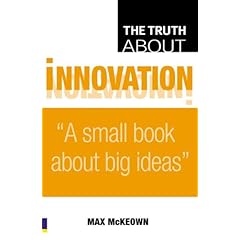

Click here to buy from Amazon

I’m going to do something I wasn’t intending to originally and that’s to list Max’s fifty-ish truths, because it occurred to me that actually these chapter headings say more about the book and the message that Max is trying to communicate than any short review could:

  • Truth 01: Innovation is new stuff that is useful
  • Truth 02: A beautiful idea is never perfect
  • Truth 03: A crisis is a terrible thing to waste
  • Truth 04: A great innovation deserves a great name
  • Truth 05: A fool can do either, a genius does both
  • Truth 06: All new ideas are made of old ideas
  • Truth 07: Bet small to win big
  • Truth 08: Better to ask forgiveness than permission
  • Truth 09: Creativity is a process not an action
  • Truth 10: Creativity is its own reward
  • Truth 11: Crowds are mad, bad,and advantageous to know
  • Truth 12: Cut innovation some slack
  • Truth 13: Cure apathy by sharing purpose
  • Truth 14: Do what your competition wont
  • Truth 15: Don’t get lost in translation
  • Truth 16: Different structural strokes for different folks
  • Truth 17: Even useless can be useful
  • Truth 18: Every company needs an idea market
  • Truth 19: Everyone can learn to think better
  • Truth 20: Find the buzz that can work for your people
  • Truth 21: Free your children before someone eats them
  • Truth 22: Get your ducks in a row
  • Truth 23: Got to share to get more
  • Truth 24: Hell hath no fury like a talent spurned
  • Truth 25: Hire for how they learn, not what they know
  • Truth 26: How much is the future worth?
  • Truth 27: Ideas are fragile, handle with care
  • Truth 28: Innovate your way out of recession
  • Truth 29: Innovation can be measured
  • Truth 30: Innovation is not everywhere
  • Truth 31: It’s a cultural thing
  • Truth 32: Just enough disunity for progress
  • Truth 33: Leaders get the innovation they deserve
  • Truth 34: Little differences make a big difference
  • Truth 35: Look outside for a bigger brain
  • Truth 36: Madonna knows more than your boss
  • Truth 37: Meeting of minds not mindless meetings
  • Truth 38: Most things will fail, get over it
  • Truth 39: Not all networks are created equal
  • Truth 40: Open spaces, open minds
  • Truth 41: People judge your first, then your ideas
  • Truth 42: Power is originality’s best friend
  • Truth 43: Quick fixes can lead to great innovations
  • Truth 44: Reinventing the wheel is a good thing
  • Truth 45: Second can be better than first
  • Truth 46: Some ideas are easier to swallow
  • Truth 47: Sometimes you have to gamble everything
  • Truth 48: Success is an S-shaped curve
  • Truth 49: The ideal design is the simplest design
  • Truth 50: This is going to hurt
  • Truth 51: Understand change to make progress
  • Truth 52: Welcome to the innovation factory
  • Truth 53: What you know can hurt you
  • Truth 54: Who the hell cares where it was built
  • Truth 55: You can’t control waves so learn to surf!

… I’ve just discovered that the Preview of the Book is available to read on Scribd here for free.

Installing PHP5 +apache2 using Macports on Leopard

I have had all sorts of fun and games trying to get php5 and apache2 installed on Leopard using macports. Six months ago I eventually gave up after lodging a ticket with macports.org no matter how hard I tried or what advise I followed it simply wouldn’t install. In the end my colleague Andrew tar’ed up his /opt folder and I copied that onto my machine and did a chown to my username/group and had a working php5 and apache2 install.

I had some problems yesterday getting yaz installed on ubuntu and decided to follow some instructions that Andrew gave me to install it on Leopard instead. I decided to bite the bullet and attempt to do a pure PHP5 apache2 install under macports again, and then use port to install php-yaz. Suffice to say that I ran into similar problems to those I encountered six months ago.

However after persevering I managed to get it all installed what follows is a summary of how I got it to work, in case anyone else out there ( and judging by the board posts that’s lots of you) is still struggling, or waiting for Macports 1.7.0 to be released.

  1.  

Once it is done follow the original instructions here.

This is so convoluted!! I hope the Macports folks sort this out. Even the ticket I raised didn’t specify the steps I took as a fix, and I basically stumbled onto them through trial and error. If anyone has a better explanation for why this worked then please let me know. Otherwise I hope it helps anyone else experiencing the same difficulties.

Touché – An open source multi-touch framework

Touché is an open-source multi-touch tracking environment for Leopard. It has been designed and written specifically for MacOS X Leopard and uses many of its core technologies, such as QuickTime, Core Animation, Core Image and the Accelerate framework.

The Touché environment consists of two parts: A standalone tracking application written in Cocoa, that comes with lots of configuration options as well as calibration and test tools, and a Cocoa framework that can be embedded into custom applications in order to receive tracking data from the tracking application. This way, you can easily experiment with MacOS X technologies such as Core Animation or Quartz Composer on your FTIR multitouch table.


Touché Multitouch Framework – Simple Demo Apps from Georg Kaindl on Vimeo.


Touché Multitouch Framework – Introduction from Georg Kaindl on Vimeo.

It’s pretty impressive stuff, but is dependent on a FTIR screen which it looks like you have to build yourself unless you can find someone to do it for you. However this might be an excellent 10% project at work for me, some of the modes of interaction I’ve been experimenting with for navigating large graphs of data would be more intuitive with a multi-touch interface … wow … *me has a cunning plan*.

Pear Tree Cottage

Me, Richard, Cliff and Simon recently represented Kings Norton Traditional Archers in the 2008 South West Challenge, which took place in Devon and Somerset, with two shoots in each county. We opted against camping given the weather wasn’t going to be particularly good and we had a lot of equipment to take care of. Richard did some research and found Pear Tree Cottage in Stapely, which was situated almost in the middle of all four locations, in fact it was no more than 45 minutes drive to any of them.

It’s a lovely thatched cottage in a beautifully picturesque surrounding. The cottage has several acres of land which you are free to roam around and is about as far away as you can get from the hustle and bustle and noise of city life. I took a number of photo’s all of which are available on my flickr acount here.

On arrival at the cottage we were greeted by our host Colvin who welcomed us and showed us to our rooms and informed us of all those important things we needed to know like watch out for low hanging beams – something I wish I had remembered a couple of days later *ouch* 🙂 . Colvin and his wife Pam live in the cottage and rent several rooms out to guests. They were wonderful hosts who really took care of us and ensured our stay was as comfortable as possible. Pam cooked a wonderful full english breakfast every morning and even catered for my dietary prejudices with a wonderful smile that makes you instantly warm to her. She is a remarkable lady who kept us entertained with her stories about the local area and her views about the government which were amusing but also deeply touching as she related the plight of the country side. Her comments did make me reflect and I couldn’t help but feel that there is something deeply wrong with the world when we neglect the countryside and the heritage and culture that the small isolated communities that live out here are trying so hard keep alive. What was inspiring though was hearing Pam describe how the people living in this these communities do everything possible to support each other.


I’ll describe the challenge itself in another post, but I wanted to emphasise just what a wonderful place the cottage is, and relate just how wonderful Colvin and Pam are. If any of you are looking a nice, quiet, place to escape to I thoroughly recommend Pear Tree Cottage. To Colvin and Pam, I’d like to say thank you 🙂 and I really look forward to seeing you again for next years shoot.

Microsoft turns Surface into a Sphere

Microsoft researcher Hrvoje Benko demonstrating the latest iteration of Microsoft’s Surface technology, called Sphere. It looks really cool, and when he shows the panoramic photos, it has a crystal ball quality that really appeals to me. The idea of using it as an interface onto Google Maps is also really compelling or certainly springs to mind when he shows the sphere rendering as a globe. Benko also demonstrates some of their ideas around what he feels are the unique advantages to a spherical display. For example multiple users can each get their own scrap of surface, which enables a kind of limited viewing privacy.

At first glance it looks awesome and you can even play Pong on it!