
I guess should begin by saying this is the first Star Wars novel I’ve ever read. I remember being at Borders book store about a month ago browsing through their collection of Manga and Graphic novels. I remember thinking about having to find a new author to read since David Gemmell had tragically died a couple of weeks earlier he was an author who’s works I had been reading since I was about 13.
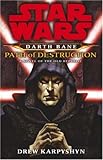
Darth Bane – Path of Destruction, by Drew Karpyshyn
Anyway during the course of my deliberations I remember glancing over at the shelf and seeing the cover to this novel and feeling intrigued … I read the cover and inlay to get a feel for what it was about … it seemed interesting … promising to recount the tale of the rise to power of the first dark lord, from his slave-like upbringing as a miner to the moment in which he changes the future of the Sith forever.
I have to admit I really enjoyed it. It was fun! It’s kind of cool to cheer for the bad guys every now and again. I guess for a long time, with series such as Star Wars and Star Trek, there’s been this condescending notion that everyone is pretty much polarised into either being good or being evil. I know that’s a gross generalisation but it does often feel like that, particularly in the clean cut universe of Star Wars. I guess what I liked about this novel was it didn’t try to treat the differences between the Sith and Jedi as a battle between good and evil. Rather it treated them as diametrically opposed philosophies, basically, about how to attain and use great power.
The story focuses on how a young miner, Dessel, is recruited into the Sith army as a foot soldier to help in the battle against the Jedi. His exploits in battle are noticed by his superiors who realise that he is unusually strong in his control of the force, but his power is latent and reveals itself at times of great stress or when he is in danger. They send him to a Sith academy where he is taught to master his powers, and in doing so transforms into Darth Bane. He realises that the Sith brotherhood has betrayed its own founding principles by trying to re-invent themselves and their structure as a mirror of the Jedi. On realising this Bane realises that the only way to ensure the future of the Sith is by destroying the Sith Brotherhood competely and then re-creating it based on the founding principle of the true Sith… the Rule of Two, “two there shall be. no more, no less; One to embody the power and the other to crave it”.
I wont reveal any more of the story, but what I will say is that it is a well written and fast paced story that surprisingly engrossing. I hope the author, Drew Karpyshyn, does follow this novel up with a sequel. Bane is a very well realised character and even though you know he represents the very “evil” that everyone who is good is “supposed” to oppose, you cant help but think that like all of us he is the sum of his experiences and the pain he endured. I guess theres a little of Bane in each of us and perhaps that’s why were drawn to him.