Couldn’t help but drool watching this …
… cant wait till I get my new Mac Book Pro …

Couldn’t help but drool watching this …
… cant wait till I get my new Mac Book Pro …
Came across a very useful Subversion utility today. SVNTimeLapseView downloads every revision of a file from your subversion repository and allows you to scroll through the revisions using a simple slider control. As you scroll through revisions it highlights the changes that were made in each revision in blue. I found it very useful earlier today when trying to figure out what had changed in a .php file when trying to understand changes made to the file by another developer. It’s a simple but very useful tool!!
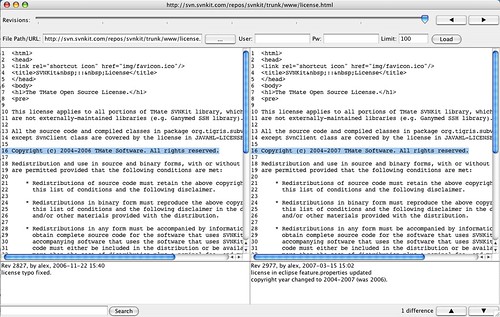
SVNTimeLapseView is free and works on any platform that runs Java, you can download it from here.
I’ve had a fascination with Japanese Swords for many years I was even fortunate enough to learn some of the skills involved in making them when I was younger. I was fascinated when I came cross this video. It turns out that if you fire bullets at a Katana, the Katana actually cuts them in half!
Magnum 140mm Vs Japanese Original Sword – video powered by Metacafe
 A relative of mine proclaimed over the weekend … “Nadeem, I have a book you might find really interesting” and presented me with this: John Cornwell’s Darwin’s Angel – an Angelic Riposte to The God Delusion.
I started reading it as soon as my cousin handed it to me, in fact I didn’t put it down till I’d finished it! It’s not a very long book, only about 160 pages, it should be noted though that the pages have unusually wide margins and considerably less text per page than most books I’ve read do. I guess what I’m trying to say is that it’s both an engrossing read but also a lot shorter than you might think when you pick it up, and whilst most people probably wouldn’t want to read it in a single sitting it’s definitely possible.
The book is basically written as an open letter to Richard Dawkins in which Cornwell, adopting the persona of a guardian angel attempts to correct the lapses of judgement in The God Delusion. Where this book differs from many of the critiques written in response to Dawkins various works is that Cornwell doesn’t fall into personal attacks, anger, or vitriol. Instead Cornwell exposes the inadequacies of Dawkins’ arguments in a gentle way which is far more devastating in its effect than anything I have ever read by Dawkins.
In fact I was hugely disappointed with Dawkin’s The God Delusion. After all his posing and positioning as an intellectual, a man of reason, a skeptic, a Humanist, I was horrified to see him use pseudo-medical terminology to try to describe religion as a virus and believers of religion as carriers of a fatal disease that is infecting the body of humanity. I mean, wasn’t it the Third Reich that used this kind of language to justify it’s atrocities against ‘Jews’ and many others? I honestly thought it was shameful for Dawkins to resort to these methods. It rang alarm bells in my head … the language and irrational venom was the sort of the thing I’d expect from a theo-fascist like Sam Harris, and the fact that Dawkin’s wont distance himself from Harris finally begins to make sense to me. Harris was the one who infamously wrote:
Certain beliefs place adherents beyond the reach of every peaceful means of persuasion, while inspiring them to commit acts of extraordinary violence against others. There is, in fact, no talking to some people. If they cannot be captured, and they often cannot, otherwise tolerant people may be justified in killing them in self defense.
I distinctly get the impression, these days, that Dawkin’s and Harris’ brand of militant atheism is little more than a personality cult. Whenever I’ve visited www.richarddawkins.net I always get the uneasy feeling that Dawkin’s wishes to replace what he sees as a belief in a fictitious God with belief in a utopia that he himself has imagined or has Cornwell accuses him of “substituting yourself for God”… and why not it’s big business right … ask the Scientologists 😉 Sadly what seems to escape Dawkins’s and his followers is that the militant form of atheism they are advocating is no different or less irrational than any other organised religion.
Anyway I’m digressing … back to Darwin’s Angel.
I guess one of the reason’s I found Cornwell’s book so enlightening is that it calmly and rationally exposes how Dawkin’s and his followers have failed to see a distinction between benign religion and dangerous fanaticism … in fact I’d go as far as to say that not only have they failed to see it but they are guilty of the very same fanaticism they attribute to religious believers. In fact Cornwell starts off the book by pointing out to Dawkins that it is wrong to bundle all religious beliefs and practise into a bag that supposedly equals fanaticism – it’s no different to saying that all science is dangerous because scientists created the nuclear bomb.
I think it was Cornwell’s chapter on Imagination that touched me the most. I found myself agreeing with him when he argued that you couldn’t simply ban religious imagination without banning the same impulses that have inspired artists and poets:
.. but you are also disturbed by imagination, aren’t you? It’s so close to art, music, poetry – stuff that’s made up rather than facts that can be reducible to physics, chemistry and biology … Biology is true whereas the other stuff is just made up! It sounds as though you would substitute a set of case notes on dementia for Shakespeare’s King Lear; or a horticultural fact sheet for Wordsworth’s “Daffodils”. Elsewhere you permit a role for literature in a science-ruled utopia, provided that it is confined to anodyne tropes about “ineffable” sunsets and “sublime” landscapes …you appear in this new book to have definitely retreated from a trust in the dynamic, protean power of imagination when it comes to religion. Have you retreated because you no longer believe in the power of the imagination to impart literary, poetic, religious and moral truth either? Or because trust in imagination threatens your militant atheism?
This really is a wonderful book and in many was serves a robust corrective to Dawkin’s The God Delusion … I thoroughly recommend it!
 Karas is a six part OVA. The first DVD, Karas:Prophecy, contains the first three parts woven into a single feature length movie. The story is set in the not-too-distant future in Tokyo which is a city populated by both humans and various supernatural beings. The balance between these two dimensions has long been upheld by a young woman called Yuri and her servent the city’s guardian raven Karas.
Karas are armored warriors. Only people who know extreme sorrow can become Karas. When commanded by the spirit Yuri these individuals becomes clothed in impenetrable armour and wield extremely powerful swords. Upon becoming Karas, the individual gains the ability to move with incredible speed and attack with amazing physical and magic power. At times, they can be moving so fast that it appears that everything around them is moving very slowly or has stopped moving completely.
Together Yuri and her Karas maintain the balance by ensuring that demons do not interfere in the lives of humans. But over time that balance was thrown into disarray when humans stopped believing in demons and stopped living in fear of them. During Japan’s Edo period the chosen Karas, disgusted by the arrogance of humans, turns his back on the laws he had once upheld, and takes the form of a human named Eku, while creating an army of Mikura, or mechanized demons, to ready an attack on the human race.
Fast forward to the future and Eku is now a wealthy magnate and his powers as a Karas have grown immeasurably. In the three hundred years or so since he betrayed his calling he has hunted down and killed every new Karas Yuri has trained. In fact the DVD opens with an incredible battle between Eku and another Karas, the fight ends when Eku dismembers and then kills opponent with ease. Yuri leaves and returns three years later with Otoha who we are led to believe is destined to defeat Eku.
Karas:Prophecy is absolutely stunning featuring some brilliant character and set designs and amazing 2D/3D hybrid animation. In terms of sound and visuals I can’t think of any other anime that comes close to this! The hyper-kinetic fight scenes are truly visceral and probably not for the squeamish.
The plot is fairly complex and I can understand why some people might struggle to keep up with it and whilst Otoha is the hero of the piece much more time is devoted to some of the characters and this is at times irritating since we don’t really get to learn as much about him as we might like. Nevertheless it’s still an amazing movie and I thoroughly recommend it!
Also the second DVD, Karas:Revelation, which contains the final three parts is being released on the 23rd October and if the visuals in the trailer are anything to go by the this second feature length movie might very well have surpassed the first.
You can watch the trailer below, enjoy:

Find out more at: http://www.karas-movie.com
Abstract
A Semantic Desktop is a means to manage all personal information across application … all » borders based on Semantic Web standards. It acts as an extended personal memory assisting users to file, relate, share, and access all digital information like documents, multimedia, and messages through a Personal Information Model (PIMO). This PIMO is build on ontological knowledge generated through user observations and interactions and may be seen as a formal and semi-formal complement of the user’s mental models. Thus it reflects experience and typical user behavior and may be processed by a computer in order to provide proactive and adaptive information support or allows personalized semantic search. The Semantic Desktop is build on a middle ware platform allowing to combine information and native applications like the file-system, Mozilla, Thunderbird or MS-Outlook. In this talk I will show how machine learning techniques may be used to support the generation of a PIMO. I will further introduce the main concepts, components, and functionalities of the Semantic Desktop, and give examples which show how the Semantic Desktop may become
I was very interested, and a little amused, when I came across this tech talk earlier this week. The talk echoed many of the ideas and points that Alan has been talking to me about recently around the whole idea of using Personal Ontology’s to provide context for applications. It’s a research area he’s particularly interested in and I’m very very excited about the prospect of working with him to develop some of his ideas using the Semantic Web Platform we’ve been building at Talis.
Alan has collaborated on papers on this subject which you can find here. Although the paper on Task Centered Information Management resonates the most with some of the ideas presented in the tech talk.
My colleague Paul visited Cambridge recently and gave an excellent talk around some of our emerging ideas about the role that Web 2.0 and the Semantic Web can play in taking us towards the ‘Web of Intentions’. Even though I work with Paul and these ideas are familiar to me, I was still amazed at how well he managed to illustrate those ideas in this presentation. You can watch the talk below:
Harriet Beecher Stowe once wrote:
The bitterest tears shed over graves
are for words left unsaid and deeds left undone.
… It occurs to me that sometimes the bitterest tears we shed aren’t necessarily over graves.
I haven’t had the best of weeks, spent the best part of two days in and out of hospital at the start of the week. Thankfully I’m ok but I did find myself feeling a certain amount of anxiety. Spent the rest of the week feeling more tired than usual – fell back on the old pattern of burying myself in work and for the most part that works quite well.
 Anyway didn’t really feel up to going out last night so I decided to stay at home and finally get round to watching Ghost in the shell : Solid State Society. The story takes place in 2034, and is set around two years after the events of Stand Alone Complex 2nd Gig.
The year is 2034, and the face of terrorism has changed. No longer restricted to the limits of the physical world, the war on terror has exploded onto the net. In an attempt to confront this new threat, an elite counter-terrorism and anti-crime unit was formed: Public Security Section 9.
Two years have passed since the team’s commander, Major Motoko Kusanagi, resigned from her post. After a rash of mysterious suicides, Section 9 is forced to confront the Puppeteer, a dangerous hacker with unsurpassed skills.
As their investigation of this terrorist threat takes them deeper into the bowels of a potential government conspiracy, Section 9 once again crosses paths with the Major, but is her sudden reappearance more than a coincidence, or is she somehow connected to the Puppeteer?
No one is above suspicion in this action-packed continuation of Ghost in the Shell: Stand Alone Complex saga!
Whilst Solid State Society is, more or less, a third installment of the SAC series it is presented more beautifully than the two GIGS with much more improved CGI imagery and sound. In terms of the story and plot for this movie the plot isn’t as complicated as some people seem to think, it revolves around the Solid State, the name given to a autonomous healthcare monitoring system that monitors Japan’s elderly who are connected together in a virtual world where they are able to continue to live with minimal effort from the state to maintain them. They are considered a burden by the state and the Solid State is seen as a way to allow them to live out there remaining years.
Unfortunately the Solid State has a program built into it called “Kugutsu Mawashi” who is referred to as the “Puppeteer”, Section 9 spends much of the early part of the movie trying to identify who the Puppeteer is and how he/she/it is involved in a string of suicides and kidnappings. Eventually it is revealed that Puppteer is a “child abduction infrastructure” built into the Solid State. I don’t reveal too much more about the plot, but although it sounds fantastical wen you consider the pervasive and totally ubiquitous nature of technology in the Ghost in the Shell universe then you realise that this is not only a complicated and intelligent movie but in it’s own, unique, way it addresses social problems such as how does a society deal with an ever increasing ageing population? Whilst this movie is very different and presents a completely different vision of the future it did for some reason make me think of, the seminal, Logans Run.
I really enjoyed the movie, and thoroughly recommend it to anyone who enjoys or is interested in anime … anyway Alanjust arrived so were off to have some fun …
Four Seasons fill the measure of the year;
    There are four seasons in the mind of man:
He has his lusty Spring, when fancy clear
    Takes in all beauty with an easy span:
He has his Summer, when luxuriously
    Spring's honied cud of youthful thought he loves
To ruminate, and by such dreaming high
    Is nearest unto heaven: quiet coves
His soul has in its Autumn, when his wings
    He furleth close; contented so to look
On mists in idleness--to let fair things
    Pass by unheeded as a threshold brook.
He has his Winter too of pale misfeature,
Or else he would forego his mortal nature.

                   by John Keats