Archery: Audley Bowman

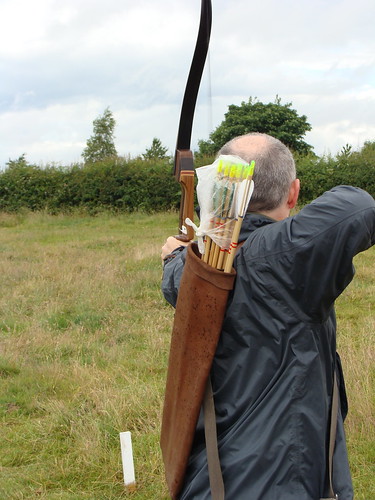
Had fun last weekend on what was my first NFAS field shoot in a couple of months, wasn’t too sure how i’d get on, but we did practise during the week leading up to the shoot at Audley Bowman’s near Stoke. We also decided that since I’m competing in the Great Devon Challenge on the 1st August, which is an 8 day shoot, I needed to switch to slightly more powerful bow. The Audley shoot was the first time I had ever shot with it and I have to confess it was not easy, I struggled to draw the bow at first, but during the course of the day I became used to it. So much so that I scored one of my highest scores ever, 484, and actually managed to outscore all the the members of our club.

It was a slightly unusual shoot from my perspective because it was divided into two separate courses, each of 18 targets. The two courses were set up in a field and in a wood about a half a mile away so it might have been a little disconcerting for the locals to see a hundred or so archers wandering through their village. It was also a very wet day, hence a lack of photos, but it was thoroughly enjoyable.

It was also the first shoot in which every member of the club took part – so KNTA was well represented on the day, it was me, Richard, Cliff, Simon, John, Tony, Phil and Alex. I was competing in the mens HT along with Simon, whilst Phil was competing in the Junior HT. Everyone else was shooting longbow on the day. Tony, Phil and Alex all won medals on the day in their individual categories which was great for them and for the club.

It was a great day, as usual all my pictures are on flickr here.

Book Thing

My friend/colleague Elliot recently did the exercise over on his blog and I thought I’d follow suit.

The rules are:

1) Look at the list and bold those you have read.
2) Italicize those you intend to read.
3) Underline the books you LOVE.
4) Strike out the books you have no intention of ever reading, or were forced to read at school and hated.
5) Reprint this list on your own blog.

I’ve adapted this slightly, and have only highlighted things I’ve read.

1 Pride and Prejudice – Jane Austen
2 The Lord of the Rings – JRR Tolkien
3 Jane Eyre – Charlotte Bronte
4 The Harry Potter Series – JK Rowling
5 To Kill a Mockingbird – Harper Lee
6 The Bible (yes I have read it all, The New International Version most recently thanks to Rob)
7 Wuthering Heights – Emily Bronte
8 Nineteen Eighty Four – George Orwell
9 His Dark Materials – Philip Pullman
10 Great Expectations – Charles Dickens
11 Little Women – Louisa M Alcott
12 Tess of the D’Urbervilles – Thomas Hardy
13 Catch 22 – Joseph Heller
14 Complete Works of Shakespeare ( yes I have, my father gifted me a copy of the complete works and I did spend an inordinate amount of time reading through it all)
15 Rebecca – Daphne Du Maurier
16 The Hobbit – JRR Tolkien
17 Birdsong – Sebastian Faulks
18 Catcher in the Rye – JD Salinger
19 The Time Traveller’s Wife – Audrey Niffenegger
20 Middlemarch – George Eliot
21 Gone With The Wind – Margaret Mitchell
22 The Great Gatsby – F Scott Fitzgerald
23 Bleak House – Charles Dickens
24 War and Peace – Leo Tolstoy
25 The Hitch Hiker’s Guide to the Galaxy – Douglas Adams
26 Brideshead Revisited – Evelyn Waugh
27 Crime and Punishment – Fyodor Dostoyevsky
28 Grapes of Wrath – John Steinbeck
29 Alice in Wonderland – Lewis Carroll
30 The Wind in the Willows – Kenneth Grahame
31 Anna Karenina – Leo Tolstoy
32 David Copperfield – Charles Dickens
33 Chronicles of Narnia – CS Lewis
34 Emma – Jane Austen
35 Persuasion – Jane Austen
36 The Lion, The Witch and The Wardrobe – CS Lewis
37 The Kite Runner – Khaled Hosseini
38 Captain Corelli’s Mandolin – Louis De Bernieres (yes it was cos a chick recommended it)
39 Memoirs of a Geisha – Arthur Golden
40 Winnie the Pooh – AA Milne
41 Animal Farm – George Orwell
42 The Da Vinci Code – Dan Brown
43 One Hundred Years of Solitude – Gabriel Garcia Marquez
44 A Prayer for Owen Meaney – John Irving
45 The Woman in White – Wilkie Collins
46 Anne of Green Gables – LM Montgomery
47 Far From The Madding Crowd – Thomas Hardy
48 The Handmaid’s Tale – Margaret Atwood
49 Lord of the Flies – William Golding
50 Atonement – Ian McEwan
51 Life of Pi – Yann Martel
52 Dune – Frank Herbert (many, many times)
53 Cold Comfort Farm – Stella Gibbons
54 Sense and Sensibility – Jane Austen
55 A Suitable Boy – Vikram Seth
56 The Shadow of the Wind – Carlos Ruiz Zafon
57 A Tale Of Two Cities – Charles Dickens
58 Brave New World – Aldous Huxley
59 The Curious Incident of the Dog in the Night-time – Mark Haddon
60 Love In The Time Of Cholera – Gabriel Garcia Marquez
61 Of Mice and Men – John Steinbeck
62 Lolita – Vladimir Nabokov
63 The Secret History – Donna Tartt
64 The Lovely Bones – Alice Sebold
65 Count of Monte Cristo – Alexandre Dumas
66 On The Road – Jack Kerouac
67 Jude the Obscure – Thomas Hardy
68 Bridget Jones’s Diary – Helen Fielding
69 Midnight’s Children – Salman Rushdie
70 Moby Dick – Herman Melville
71 Oliver Twist – Charles Dickens
72 Dracula – Bram Stoker
73 The Secret Garden – Frances Hodgson Burnett
74 Notes From A Small Island – Bill Bryson
75 Ulysses – James Joyce
76 The Bell Jar – Sylvia Plath
77 Swallows and Amazons – Arthur Ransome
78 Germinal – Emile Zola
79 Vanity Fair – William Makepeace Thackeray
80 Possession – AS Byatt
81 A Christmas Carol – Charles Dickens
82 Cloud Atlas – David Mitchell (good, but not that good)
83 The Color Purple – Alice Walker
84 The Remains of the Day – Kazuo Ishiguro
85 Madame Bovary – Gustave Flaubert
86 A Fine Balance – Rohinton Mistry
87 Charlotte’s Web – EB White
88 The Five People You Meet In Heaven – Mitch Albom
89 Adventures of Sherlock Holmes – Sir Arthur Conan Doyle (have the complete works, i loved this stuff, sad I know)
90 The Faraway Tree Collection – Enid Blyton
91 Heart of Darkness – Joseph Conrad
92 The Little Prince – Antoine De Saint-Exupery
93 The Wasp Factory – Iain Banks
94 Watership Down – Richard Adams
95 A Confederacy of Dunces – John Kennedy Toole
96 A Town Like Alice – Nevil Shute
97 The Three Musketeers – Alexandre Dumas
98 Hamlet – William Shakespeare
99 Charlie and the Chocolate Factory – Roald Dahl
100 Les Miserables – Victor Hugo

The Fighter

Read this and couldn’t help but smile … the last six months has felt like a constant battle, like I’m constantly treading water …


       The Fighter
     
I fight a battle every day
Against discouragement and fear;
Some foe stands always in my way,
The path ahead is never clear!
I must forever be on guard
Against the doubts that skulk along;
I get ahead by fighting hard,
But fighting keeps my spirit strong.

I hear the croakings of Despair,
The dark predictions of the weak;
I find myself pursued by Care,
No matter what the end I seek;
My victories are small and few,
It matters not how hard I strive;
Each day the fight begins anew,
But fighting keeps my hopes alive.

My dreams are spoiled by circumstance,
My plans are wrecked by Fate or Luck;
Some hour, perhaps, will bring my chance,
But that great hour has never struck;
My progress has been slow and hard,
I've had to climb and crawl and swim,
Fighting for every stubborn yard,
But I have kept in fighting trim.

I have to fight my doubts away,
And be on guard against my fears;
The feeble croaking of Dismay
Has been familiar through the years;
My dearest plans keep going wrong,
Events combine to thwart my will,
But fighting keeps my spirit strong,
And I am undefeated still!

        by S.E. Kiser

… but there’s a lot to be said for never giving in.

{TWR} Meeting in Knightcote

Last weekend I met up with some of my team mates from {TWR} for one of our annual get-togethers. Rather embarrassingly I hadn’t bothered to even find out where we were spending the weekend till the night before – several months ago when the plans were first made I think I said something like … “I don’t care where it is, I’ll be there!”, and never really got round to checking on how the guys were getting on with organising the venue, but that’s really a testament to how much I trust Alan and Wim. previous venues for our get-togethers have included New York, Ghent in Belgium, Oxford and an assortment of other cities around the UK.

For those who don’t know {TWR} stands for Team Wolfenstein Resource, its an FPS gaming clan that plays several games created by idSoftware, these include the original Return to Castle Wolfenstein, and it’s sequels Wolfenstein Enemy Territory and the recent Enemy Territory Quake Wars, some of us also play Quake 4. We are, as you might imagine, a pretty diverse bunch – if the phrase unity of opposites ever applied to anything then its definitely a moniker that fits {TWR}. Whilst it’s easy to try to dismiss us a bunch of gaming geeks the reality is that although we all share a common interest the friendships that we have formed have transcended that – the truth is the game is now simply a way we keep in touch, rather than the reason we do. Events like this are really so we can all catch up and see how everyone is doing.

This get-together was special because it was the first time Mike, the founder of Wolfensteinresource.com was able to attend given that he lives in Melbourne in Australia. We chose a weekend that we knew he’d be in the UK visiting relatives with his wife Analina and their son Brodie, who spent most of the weekend clambering over me or chasing me round the kitchen table – he’s a wonderful kid! The weekend was full of humour, it’s a {TWR} tradition to make fun of each other as much as we can, and whilst I’m not going to recount any specific things here, I did laugh my head off when Wim presented me with a radio controlled K.I.T.T car from Knight Rider – it’s an ongoing joke πŸ™‚ .


Mark+Lois,Me,Wim,Analina+Mike+Brodie,Penny+Alan


Wim+Julia, Penny+Alan, Me,Lois+Mark,Joanne+Marcus

Like all of our events it was awesome, the house that Wim found for us to stay in was amazing and the day out in Stratford Upon Avon was also a lot of fun πŸ™‚ It was nice to leave everything behind for a weekend and simply have a laugh πŸ™‚ even if it was mostly at my expense ( thanks Alan! πŸ™ lol ). I can’t wait for the next one.

I’ve uploaded a selection of pictures to my flickr account, and so did Alan to his Picasso account.

To everyone who took part I want to say … Thank You!

The Conflict of Convictions

Been feeling torn lately … so I’ve been reflecting a lot on why that is … was almost ironic that during my introspection I recalled a passage from one of Melville’s old poems, I’ve transcribed the piece below in full …

    The Conflict of Convictions
       by Herman Melville

On starry heights
  A bugle wails the long recall;
Derision stirs the deep abyss,
  Heaven's ominous silence over all.
Return, return, O eager Hope,
  And face man's latter fall.
Events, they make the dreamers quail;
Satan's old age is strong and hale,
A disciplined captain, gray in skill,
And Raphael a white enthusiast still;
Dashed aims, at which Christ's martyrs pale,
Shall Mammon's slaves fulfill?

    (Dismantle the fort,
    Cut down the fleet--
    Battle no more shall be!
    While the fields for fight in Γ¦ons to come
    Congeal beneath the sea.)

The terrors of truth and dart of death
  To faith alike are vain;
Though comets, gone a thousand years,
    Return again,
Patient she stands--she can no more--
And waits, nor heeds she waxes hoar.

    (At a stony gate,
    A statue of stone,
    Weed overgrown--
    Long 'twill wait!)

But God his former mind retains,
  Confirms his old decree;
The generations are inured to pains,
  And strong Necessity
Surges, and heaps Time's strand with wrecks.
  The People spread like a weedy grass,
  The thing they will they bring to pass,
And prosper to the apoplex.
The rout it herds around the heart,
  The ghost is yielded in the gloom;
Kings wag their heads--Now save thyself
  Who wouldst rebuild the world in bloom.

    (Tide-mark
    And top of the ages' strike,
    Verge where they called the world to come,
    The last advance of life--
    Ha ha, the rust on the Iron Dome!)

Nay, but revere the hid event;
  In the cloud a sword is girded on,
I mark a twinkling in the tent
  Of Michael the warrior one.
Senior wisdom suits not now,
The light is on the youthful brow.

    (Ay, in caves the miner see:
    His forehead bears a blinking light;
    Darkness so he feebly braves--
    A meagre wight!)

But He who rules is old--is old;
Ah! faith is warm, but heaven with age is cold.

    (Ho ho, ho ho,
    The cloistered doubt
    Of olden times
    Is blurted out!)

The Ancient of Days forever is young,
  Forever the scheme of Nature thrives;
I know a wind in purpose strong--
  It spins against the way it drives.
What if the gulfs their slimed foundations bare?
So deep must the stones be hurled
Whereon the throes of ages rear
The final empire and the happier world.

    (The poor old Past,
    The Future's slave,
    She drudged through pain and crime
    To bring about the blissful Prime,
    Then--perished. There's a grave!)

  Power unanointed may come--
Dominion (unsought by the free)
  And the Iron Dome,
Stronger for stress and strain,
Fling her huge shadow athwart the main;
But the Founders' dream shall flee.
Agee after age shall be
As age after age has been,
(From man's changeless heart their way they win);

And death be busy with all who strive--
Death, with silent negative.

    YEA, AND NAY--
    EACH HATH HIS SAY;
    BUT GOD HE KEEPS THE MIDDLE WAY.
    NONE WAS BY
    WHEN HE SPREAD THE SKY;
    WISDOM IS VAIN, AND PROPHESY.

Talis – Xiphos Research Day

Earlier in the week we at Talis hosted a Research Day the theme for which was around what we refer to as Project Xiphos. Through Project Xiphos, we are exploring the impact of applying the latest Web scale technologies, including Web 2.0 and the Semantic Web, to the challenges of education and research within Higher Education institutions.

The program for the day was quite varied, with speakers talking about a number of different issues related to higher education We opened with Peter Murray-Rust from the University of Cambridge, who spoke passionately about the need to open up research and research data. Following him was Andy Powell from Eduserv who talked about Web 2.0 and Repositories, I found his talk to be rather enlightening since I’m fairly new to this domain and still learning. Following Andy was Carsten Ullrich from Shanghai Jiao Tong University. Carsten had flown in from China to give a presentation on “Why Web 2.0 is Good for Learning and for Research: Principles and Prototypes“. I had already seen a variation of this presentation at WWW2008 last month, in fact those of us who were there felt that his ideas were hugely relevant to some of the issues we are trying to understand around Higher Education so we invited him to speak at our event. Carsten is based in the e-learning lab – and is researching into how learning can be made easier and more interactive using technology. Most recently his team have been looking at Web 2.0 technologies/approaches and how they can applied to learning. What they found is that these approaches were transformational, in other words that you you have to change the way you teach to use these approaches and benefit from them. The final speaker before lunch was Alan Massen from University of Ulster, who presented a project he has been involved in using a Hybrid Learning Model to Describe Learning Practices. The model he presented addresses a issue in higher education around the fact that teachers don’t posses vocabulary to describe their teaching practice/pedagogy, and actually this information is quite important to students as well since it can be used to help them understand their learning goals. After lunch my colleague Chris presented one of our research prototypes, Xiphos Network, which creates a social network from a Web Scholarly Data. Following him another of my colleagues, Ian Corns, presented Project Zephyr, a resource (reading) list application that we will soon be trialling with several institutes here in the UK. Following this, the final session of the day was me, giving a presentation on Open World Thinking. The remainder of this post will focus on what I said during that presentation, with some links at the end to my slides.

Open World Thinking

I started off by introducing myself and explained that whilst my colleagues had presented some examples of applications we had developed that addressed some of the issues raised during the day, my talk was going to be slightly more esoteric … and understanding that we might need to change the way we think about problems.

In order to set the tone for some of what I wanted to address later in the presentation and in attempt to get the audience to start to appreciate the complexity of some of the problems we want to be able to solve but currently can’t because of the way we think about things I posed a couple of questions for the audience:

1. What is the most referred to text in first year
    undergraduate computer science courses in the UK?

and

2. Based on pedagogical approaches, what are the
    recommended resources required to teach an
    emerging subject in a new department a University
    somewhere?

The questions are largely rhetorical, or just plain impossible to answer. So they next thing I asked was whether the audience felt that the reason we couldn’t answer the question was because the data didn’t actually exist? I stated that I believed that the data probably did exist but if it did then it existed within individual institutions, across a myriad of internal systems, and sometimes even across departments. This led me to make the observation that Higher Education Institutes are not just silos they are in fact “silos within silos”. I also pointed out that as long as they remained silos we wouldn’t ever be able to answer the kinds of questions I had posed earlier. Which is the fundamental reason why we need to start finding ways of linking data together across these silos.

I diverted slightly to ask the question “Why have we ended up with silos?”, and offered my own answer that really these silos were a product of close world thinking, historically the systems implemented with institutions where designed to solve a set of problems for that institution, they were never designed with interoperability in mind, and were really about controlling data. However the problems we are trying to solve today are different to the problems of old, the world has changed and so we need to change too. One way of addressing these problems of interoperability, problems of sharing and reuse is to be more Open. Tim Berners-Lee said that “Openness tends to be an inexorable movement through time” and that’s something that I believe is true. I mentioned that I wanted to talk about two aspects of this what I describe as an Openness of Description and an Openness of Access.

However before going any further I wanted to make an important point, that what absolutely not talking about is a technology change. What I’m talking about is a paradigm shift, a very different way of thinking about the problems we are trying to solve. I then displayed a picture of the Linked Data Graph with another of Tim’s quotes that “Linked Data is the Semantic Web done right, and the Web done right”. I explained that this graph represented data sets published by communities in an agreed form in order to facilitate re-use and linking disparate data sets together. Through this level of openness others can come along and build new applications and services that use this data. I talked about how this facilitates the notion of “Designing for Appropriation”, where the creators of an artifact might intend it for a purpose but others can appropriate it for a completely different use. This is also the promise of the semantic web the fact that we no longer need to rely on structures to be defined up front, we can slice and dice this graph of data in order to create structures on the fly. However in order to achieve this we need to design data at the right level of granularity.

So openness of description is about agreeing on ways of describing certain kinds of things. When you have shared, open ways of describing things it makes it easier to Share, to relate things together and to integrate across. I also anecdotally pointed out that as Rob had pointed out to me “through openness of description and dereferencible URI’s you get interoperability for free”, which is true … kind of πŸ˜‰

One way agreeing on shared descriptions is through the use of Ontologies, I explained what they were and cited a few examples. In order to illustrate the point further I used Alan Massen’s Hybrid Learning model as an example and suggested that since it was a “controlled vocabulary” that defined a set of “concepts” and the “relationships between those concepts” what he actually had was the basis of any ontology. I also suggested that if every institution in the UK/World used this ontology to describe their courses you could present an enormous amount of information to students in a standard way which might make the selection of courses or indeed the choice of which institution to go to more transparent in terms of the learner understanding what the institute provides and how, but also what is expected of them as students.

I pointed out that Talis has worked on developing a number of ontologies that are all being used to underpin the applications we are producing as part of Xiphos, but others outside of Talis have also started to adopt. I pointed the audience to www.vocab.org for more information.

I then went on to talk about Openness of Access ( which is not Open Access ), it’s the idea that we need to provide users with ability to consume content and information anywhere, anytime, anyhow. I also pointed out that unless we do this we can’t create the kind of truly personalised learning experiences we envisage. Part of this is recognisng what I’ve referred to a lot recently as the need to develop applications as Contextualised Perspectives onto this amorphous web of scholarly data.

This is a large part of the paradigm shift, recognizing that if this Web of Scholarly Data exists then we don’t own it, it exists independently of the applications and services that are built upon it. However it becomes the job of application vendors or developers to create value by developing Contextualised Perspectives onto that graph of data that allow their users to perform a set of activities, or achieve some goals that he or she sets out to. In other words this Web of Scholarly Data allows us to create contexts on the fly that are relevant for a task your doing at the time your doing it … in some ways thats the grand vision. A perspective could be a facebook application, or an iPhone app, or some functionality embedded in an institutions VLE, an enterprise application … anything … but the point is that we need to create these perspectives since it’s only through them that ordinary users can make sense of it all.

… *phew* … I think i’ve pretty much covered most of what I said … however for a slightly more coherent view of it all, I’ve written a piece on Open World Thinking in issue 2 of Nodalities.

You can access the slides here.

I’m an INFP … apparantly …

Earlier this week I took one of those Myers-Briggs Personality Type Indicator tests … and according to it … I’m an INFP which stands for Introversion, iNtuition, Feeling, Perceiving. I wasn’t quite sure how to react to that … I didn’t really think too much before taking the test, it felt like it was a bit of a joke, and afterwards I wasn’t too sure how to feel about it … largely because I didn’t fully understand what it meant … then I read this description of an INFP ..

The polite, reserved exterior of INFPs can at first make them difficult to get to know. They enjoy conversation, however, taking particular delight in the unusual. When INFPs are in a sociable mood, their humor and charm shine through. Disposed to like people and to avoid conflict, INFPs tend to make pleasant company.

Devoted to those in their inner circle, INFPs guard the emotional well-being of others, consoling those in distress. Guided by their desire for harmony, INFPs prefer to be flexible unless their ethics are violated. Then, they become passionate advocates for their beliefs. They are often able sway the opinions of others through tact, diplomacy, and an ability to see varying sides of an issue.

INFPs develop these insights through reflection, and they require substantial time alone to ponder and process new information. While they can be quite patient with complex material, they are generally bored by routine. Though not always organized, INFPs are meticulous about things they value. Perfectionists, they may have trouble completing a task because it cannot meet their high standards. They may even go back to a completed project after the deadline so they can improve it.

INFPs are creative types and often have a gift for language. As Introverts, they may prefer to express themselves through writing. Their dominant Feeling drives their desire to communicate, while their auxiliary iNtuition supplies the imagination. They enjoy metaphors and similes, having a talent for symbolism. They continually seek new ideas and adapt well to change. They prefer working in an environment that values these gifts and allows them to make a positive difference in the world, according to their personal beliefs

So there was something that felt familiar in all that … and for the most part It does feel familiar, although I don’t know why that admission makes me feel awkward. I asked a couple of friends of mine to read it and asked what they thought … they seemed to think it did reflect the kind of person I am … which on one hand feels pretty cool … but on the other hand the notion that my I, or anyone, can be analyzed and reduced down to a four letter acronym disturbs me quite profoundly.

Memes and “temes’

Susan Blackmore studies memes: ideas that replicate themselves from brain to brain like a virus. She makes a bold new argument: Humanity has spawned a new kind of meme, the teme, which spreads itself via technology — and invents ways to keep itself alive

A fascinating TED Talk, if we believe Susan then Darwin’s idea’s around evolution are not just applicable to biology they also apply to culture. “Memeticsis a neo-Darwinian approach to evolutionary models of cultural information transfer based on the concept of the meme. This is the theory that, like living things, ideas or ‘memes’ – naturally vary and that the fittest ideas survive and are absorbed into a our psyche and replicated across generations. Susan argues that Earth now has three replicators – genes (the basis of life), memes (the basis of human culture) and temes (the basis of technology). Technology, through temes, she argues, is now driving us forward as a species, whether we like it or not.

You can read more about this over on Susan’s site.

A life of fascinations

Truly inspirational … Nathan Myhrvold talks about a few of his latest fascinations — animal photography, archeology, BBQ and generally being an eccentric genius multimillionaire. Listen for wild stories from the (somewhat raunchy) edge of the animal world.