
Steve Noonan maintains a page where he collects and publishes results for various browsers tested against the newly released ACID3 Standards. Unsurprisingly no browser currently scores 100%, and it’s not surprising to me that Internet Explorer is way down the bottom of the list for compliance … but how the hell did IE5 score more than IE6 and IE7?
Personalising my MacBooK Pro
Rob has been telling me for ages to personalise my Mac somehow ever since he put some Le Manns stripes on his – which look really cool. I finally gave in and here’s what I’ve done … click the image to enlarge:

I chose the dragon because in both Chinese and Japanese mythology they represent celestial and terrestrial power, wisdom and strength … but mostly because it looks cool 😉 and kind of works wrapped around the Apple logo.
Yin and Yang represent a unity of opposites. A friend of mine was joking today that I had a lot of that going on, she was right … and so it seemed apt.
Finally my VirtualChaos Logo, I just had to get the ‘fairy’ on it somehow 😉
Ae Fond Kiss, and then We Sever
          Ae Fond Kiss, and then We Sever


Ae fond kiss, and then we sever;
Ae fareweel, and then for ever!
Deep in heart-wrung tears I'll pledge thee,
Warring sighs and groans I'll wage thee.

Who shall say that Fortune grieves him
While the star of hope she leaves him?
Me, nae cheerful twinkle lights me,
Dark despair around benights me.

I'll ne'er blame my partial fancy;
Naething could resist my Nancy;
But to see her was to love her,
Love but her, and love for ever.

Had we never loved sae kindly,
Had we never loved sae blindly,
Never met -or never parted,
We had ne'er been broken-hearted.

Fare thee weel, thou first and fairest!
Fare thee weel, thou best and dearest!
Thine be ilka joy and treasure,
Peace, enjoyment, love, and pleasure!

Ae fond kiss, and then we sever;
Ae fareweel, alas, for ever!
Deep in heart-wrung tears I'll pledge thee,
Warring sighs and groans I'll wage thee.

                       by Robert Burns
Why is 37 signals so arrogant?
If your going to say things like:
“Arrogant is usually something you hurl at somebody as an insult … But when I actually looked it up — having an aggravated sense of one’s own importance or abilities’ — I thought, sure … Call it arrogance or idealism, but they would rather fail than adapt. I’m not designing software for other people, I’m designing it for me.”
– David Heinemeier Hansson, 37 Signals
… then your probably going to get upset people … like Don Norman, who lambastes 37 Signals in his latest blog post.
I have used some of 37 Signal’s products and I have to agree with Norman when he says that:
I’ve tried their products and although they have admirable qualities, they have never quite met my needs: Close is not good enough.
I’ve always struggled with BaseCamp for example, it almost there but just not quite … I always put my frustrations down to the fact the tool was designed to be simple, but after reading some of Hansson’ statements I begin to see things slightly differently.
When your designing products for a large user base you can’t ignore the users. I find myself agreeing with Norman’s final observation:
Understanding the true needs of customers is essential for business success. Making sure the product is elegant, functional and understandable is also essential. The disdain for customers shown by Hansson of 37signals is an arrogance bound to fail. As long as 37signals is a hobby, where programmers code for themselves, it may very well succeed as a small enterprise with its current size of 10 employees. I’m happy for them, and for the numerous small developers and small companies that find their products useful. But their attitude is a symbol: a symbol of eventual failure. Too bad. In fact, that attitude is not so much arrogance as it is selfishness: they are selfish. A little less arrogance and a lot more empathy would turn these brilliant programmers into a brilliant company, a brilliant success.
Mirage
                  Mirage

The hope I dreamed of was a dream,
Was but a dream; and now I wake,
Exceeding comfortless, and worn, and old,
For a dream's sake.

I hang my harp upon a tree,
A weeping willow in a lake;
I hang my silent harp there, wrung and snapped
For a dream's sake.

Lie still, lie still, my breaking heart;
My silent heart, lie still and break:
Life, and the world, and mine own self, are changed
For a dream's sake.

    by Christina Georgina Rossetti
Automated Testing Patterns and Smells
Wonderful tech talk by Gerard Meszaros who is a consultant specialising in agile development processes. In this particular presentation Gerard describes a number of common problems encountered when writing and running automated unit and functional tests. He describes these problems as “test smells”, and talks about their root causes. He also suggests possible solutions which he expresses as design patterns for testing. While many of the practices he talks about are directly actionable by developers or testers, it’s important to realise that many also require action from a supportive manager and/or system architect in order to be really achievable.
We use many flavours of xUnit test frameworks in our development group at Talis, and we generally follow a Test First development approach, I found this talk beneficial because many of the issues that Gerard talks about are problems we have encountered and I don’t doubt every development group out there, including ours, can benefit from the insight’s he provides.
The material he uses in his talk and many of the examples are from his book xUnit Test Patterns: Refactoring Test Code, which I’m certainly going to order.
On the verge of creating synthetic life
Craig Venter made headlines back in 2001 for sequencing the human genome, then he went on to trying to map the oceans biodiversity, and currently he’s working on a project to create the first synthetic lifeforms – micro-organisms that can produce alternative fuels, and according to this presentation … hes very very close to achieving that!
The talk covers the details of creating brand new chromosones using digital technologies. What makes this so amazing is that this technology has the potential to change the world, it would allow humans to create Synthetic Bacteria that are engineered to perform specific reactions: produce fossil fuels, make medicines, combat global warming1 etc.
In a recent interview with New Scientist Venter described how this technology would hopefully reduce our dependency on fossil fuels2:
Over the next 20 years, synthetic genomics is going to become the standard for making anything. The chemical industry will depend on it. Hopefully, a large part of the energy industry will depend on it. We really need to find an alternative to taking carbon out of the ground, burning it, and putting it into the atmosphere. That is the single biggest contribution I could make.
Not everyone seem’s too happy with this, with accusations that Venter is trying to play God. How much you subscribe to that view depends on one’s own religious perspective. I was encouraged to come across a wonderful critique that addresses this question from a Muslim perspective, which is well worth reading3, the author offers a conclusion of sorts:
I approached Dr Venter after the lecture and asked him whether any religious groups had raised objections about his work (I do wonder what he thought of a hijab-clad woman asking him such a question). He replied in the negative, reminding me that his work did not begin until the project had been subjected to a 1.5 year ethical review. He in turn asked me: “Why? Should there be [any objection]?â€. After hearing the facts, and mulling it over, the only answer that came to my mind was: “Noâ€, and upon further reflection, I still stand by my answer – and Allah knows best.
If Venter succeeds the implications specifically for the Pharmaceutical and Chemical Industries as well as the world at large are profound.
- http://www.telegraph.co.uk/news/main.jhtml?xml=/news/2007/06/08/nbiofuel108.xml[back]
- New Scientist, Issue 2626 page 57[back]
- MuslimMatters.org, Craig Venter Playing God[back]
Seven Samurai and Samurai7
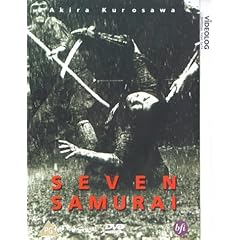 Akira Kurosawa’s Seven Samurai is not only one of the greatest films of all time it also happens to be one of my favourites. It’s one of those movies I tend to go back and watch more often than I probably ought to. It’s one of those films that for some strange reasons I take great comfort in, the sort of thing that I kind find inspiration in when I need it, or loose myself in when I don’t really want to think about something else, like today.
For those who aren’t familiar with it the plot revolves around a small villages struggle to stave off a group of marauding bandits. In order to do this they recruit Seven samurai to defend them, but because the village is so poor the samurai will be paid only the rice they eat. The film is over three hours long, in fact over an hour of the film is dedicated to the villagers struggle to find and recruit a number of samurai willing to fight for them, for so little reward.
The movie is very emotive,particularly in the opening half hour the plight of the farmers is almost unbearable to watch such is their suffering. The task of hiring samurai seems impossible especially when all they have to offer is rice. What makes this such a classic movie though is the depth of detail and characterisation Kurasawa provides, and the painstaking effort he makes in creating a sense of 16th century Japanese society. The interactions and tensions between the samurai and the villagers are frequent and often awkward, each group having its reasons to mistrust the other. The samurai could oppress the villagers as much as the bandits.
Call me a romantic but for me what makes the movie truly magical lies in how the heroism of the seven emerges in their willingness to do what is right, no matter the outcome, and to help those who need it without making judgements about their fallabilities or their occasional immorality. Even the end of the film is striking with the battle won the villagers celebrate their victory but ignore the samurai for whom they no lnger have any use, leaving the surviving samurai to reflect on the relationship between the warrior and farming classes.
Kurasawa’s movie was one of the first to use, the now common, plot device of recruiting and gathering a group of heroes into a team to accomplish and impossible mission. Another of my favourite movies The Magnificent Seven, is a recreation of this. In fact this movie served as the inspiration for a swathe of others, and there are many, like me, who subscribe to the view that Kurasawa’s classic pioneered the modern action movie. The final rain soaked battle scene is without a doubt one of the most stunningly filmed sequences ever. If you have never seen this movie you must watch it , you will not be disappointed!
 On the back of this I’ve recently finished watching the complete series of Samurai 7. This anime series is based on Kurasawa’s classic but sets the story in a bleak future where the bandits, or Nobesari, are plundering villages all over the land. These men are former Samurai’s who have abandoned their code of honour and adapted technology to their bodies until they no longer resemble humans.
The series is made up of 26 half hour episodes, and much in the same way Kurasawa dedicated so much of his film to detailed characterisation so too does this series. The quality of the animation and sound is absolutely superb. I thoroughly recommend it, but only after you have seen Kurasawa’s classic!
VMWare Fusion – wonderful!
I’ve been running VMWare Fusion on my MacBook Pro since I got it. Last week I finally got round to installing a Windows XP Professional virtual machine. The virtual machine runs beautifully and feels as though I’m running it natively such is it’s responsiveness. Almost as soon as I had the VM installed and running I immediately installed Windows Liver Writer lol. But then I noticed the Unity Icon, what this basically does is minimise the VM Window and allow you to run applications inside the VM directly on your Mac Desktop, here’s my desktop running Windows Liver Writer, Paint and a Windows Command Prompt (click to enlarge):

What makes this truly wonderful is that I can place windows applications directly into the dock in order to launch the applications. Here’s the neat bit, even if the VM isn’t running when I try to launch and app, Fusion starts up the VM and switches into Unity automatically.
Superb!
User generated content vs The Experts
Came across this article in Newsweek, entitled Revenge of the Experts, that suggest that the era of user generated content is going to change in favour of a more traditional approach based around fact checking and rigorous standards. This notion isn’t new and it’s been argued for, quite vociferously, by the likes of Andrew Keen in his book The Cult of the Amateur, which I’ve talked about before. According to the article:
the expert is back. The revival comes amid mounting demand for a more reliable, bankable Web. "People are beginning to recognize that the world is too dangerous a place for faulty information,"
Whist I understand the need for authoritative information, we have seen that the wisdom of the crowds does work – the most notable example of which is Wikipedia, which has over 75,000 people from around the world collaborating together to generate over 9 million articles in 250 different languages. A feat that I believe could not have been accomplished through any traditional publishing model.
It’s interesting that in the article we are told that two of the contributory factors leading to creating a "perfect storm of demand for expert information" are choice fatigue and fear of bad advice. I’m not actually convinced by either. I think the real reason for this resurgent push towards this "Revenge of the Experts" is largely based on economics, and a type of intellectual elitism that requires the masses to believe that they can only trust the opinions of experts. I really struggle with this – it offends my sense of right. . I don’t doubt that there are many subject matter experts writing articles in Wikipedia, they might identify themselves or they might hide behind assumed pseudonyms and the anonymity of the web, and I’m sure many of the contributors are hobbyists or individuals particularly passionate about a subject: I wouldn’t wish to discount their insight simply because they aren’t rubber stamped by an Institute somewhere. If the community is engaged and self regulating then it definitely does work.
It strikes me as a form of intellectual elitism; the expert is always right? – and yet research carried out seems to suggest that Wikipedia is almost as accurate as the Encyclopedia Britannica. Which seems to suggest that this model can work?
"The wisdom of the crowds has peaked … Web 3.0 is taking what we’ve built in Web 2.0—the wisdom of the crowds—and putting an editorial layer on it of truly talented, compensated people to make the product more trusted and refined."
I think economics does have a lot to do with it. Google has incentivised Knol, it’s Wikipedia-like alternative, by sharing ad revenue with the "authoritative" sources that are generating the content of the service. But frankly I don’t believe that this or other similar initiatives really spell the death knell for the kind of community generated content that has gained traction …
…while the tide of investment seems to be shifting somewhat, the nature of the Internet suggests that Web 2.0 populism will never be thrown out entirely.
I guess time will tell.