Talis gets some nice Semantic Web coverage

Last week Talis has had some interesting coverage on Read/Write Web, a popular semantic web blog. It started off with the article ‘Ten Semantic Web Apps to watch‘, by Richard MacManus. I enjoyed reading Richard’s article and it was interesting to see who else he thought was worth watching in this space. Richard seemed to capture the essence of some of what we are trying to achieve with our platform quite well …

They are a bit different from the other 9 companies profiled here, as Talis has released a platform and not [just] a single product. The Talis platform is kind of a mix between Web 2.0 and the Semantic Web, in that it enables developers to create apps that allow for sharing, remixing and re-using data. Talis believes that Open Data is a crucial component of the Web, yet there is also a need to license data in order to ensure its openness. Talis has developed its own content license, called the Talis Community License, and recently they funded some legal work around the Open Data Commons License

That’s exactly right, by building applications on our platform the data that these applications rely on is stored in a way that allows it be easily re-used and re-mixed. What’s more is that the platform does hide away some of the underlying complexities inherent in Semantic Web technologies by presenting developers with a easy to use, RESTful API that allow you to store, query and manage heterogeneous data. Whilst the platform will continue to grow and evolve it’s already matured to the point where we are building and deploying commercial applications on it i.e. Talis Engage. For me personally the last twelve months have been very exciting and challenging as we’ve seen the Platform mature to the point where we can do the very things we’ve been talking about for ages.

Soon after Richard’s article was posted, my colleague Paul Miller was interviewed by Read/Write Web’s Marshall Kilpatrick. Paul provided more of an insight into the platform and Talis and offered some of his own views on the future of the Semantic Web which is well worth reading.

And then yesterday Andreas Blumauer, of the Semantic Web Company, posted this nice little piece up on his blog.

Talis is a “domain-agnostic” technology platform which supports developers to build applications on the principles of “mass collaboration”. It is a new breed of a distributed programmatic interface heavily deploying all opportunities the Web of Data may offer …. Talis tries to establish a new way of organizing information flows throughout the Web of Data. Since it relies on open standard protocols like RESTful Web Services a lot of applications will use Talis technologies. Talis as a company has a well founded background since it has been provided services for governmental organizations or libraries for the last 30 years. Some of the people working at Talis rank among the best semantic web thinkers.

… Is it wrong to admit that reading that gave me a nice warm fuzzy feeling … ?

Benefits of Open Sourcing Code

Open Source Developers @ Google Speaker Series: Ben Collins-Sussman and Brian Fitzpatrick

What’s In It for Me? How Your Company Can Benefit from Open Sourcing Code

As the open source community continues to clamor for more companies to open source their code, more and more executives are asking themselves just what open source can do for their company. There are a number of ways for a company to open source an internal project: from tossing code over the wall on the one hand to running a fully open development project on the other to any combination of the two.

This talk will discuss the costs and benefits associated with each method as well as how to successfully launch your new open source project.

I really enjoyed this tech talk about the benefits of open sourcing code. and Brian briefly summarise what motivates people working on projects to make them open source:

  • a desire to create better software,
  • or to create a relationship with you users,
  • or in some cases it’s simply good PR,
  • or perhaps it’s simply goodwill on the part of some techies,
  • or it can be a way to get free labour .
  • or it can be a way to change or subvert an entire industry ( take over the world )

They also provide a useful set of criteria with which to measure the health of an open source project, you can do this by measuring the health of the community:

  • Lots of usage ( not users! )
  • A number of active developers
  • Constant improvements and releases
  • No community == dead software

I liked their descriptions of the various differnt approaches organisations take when open sourcing software, these range from the Fake Approach, where organisations rather cynically decide to Open Source their code but do so without using a license approved by the open source initiative, this is little more than a PR exercise and in real terms means the code isn’t really open source and it can alienate both users and developers.

The second approach is to Throw Code Over The Wall, this basically means you remove any names from the code files, you add the appropriate licenses, you tar the whole thing up, post it and then simply walk away. This generates PR and is relatively effortless but it still doesn’t create a community nor does it really attract real techies. You often find that organisations that no longer wish to continue maintaining some piece of software use this approach.

Then there is the Develop Internally, Post Externally. You have a public code repository, where you develop in house but allow the external world to see what your doing. This allows occasional volunteers to submit patches but really there’s no incentive for outsiders to get involved because your not really giving anyone outside the organisation a sense of ownership … this can lead to mistrust, and creates barriers..

Next you have the Open Monarchy, where there are public discussions, there is a public repository, but committers are mostly employees and occasionally individuals outside the organisations. However in this approach one organisation or one individual rules the project and makes all the key decisions. This approach has the benefit that it will garner more credibility from the technical community and you probably will find more volunteers stepping forward to participate in the open discussions your having and to sometimes contribute. But the reality is that this is virtually the same as the previous approach except the discussions are taking place in public and as thus people can participate even though the corporate agenda always wins.

Finally there is Consensus Based Development, in which almost everything is public, all decisions are based on a consensus of the committers – project is its own organisation it exists independently of any organisation. In order to join the community you have to earn your access in other words you have to earn commit privileges. The advantage of this approach is that you build a long term, sustainable community, with a passionate following of committed developers which invariably results in better software.

I found the talk to be extremely informative and it raised my awareness or certainly made me re-think what my definition of open source actually is. In fact this is all particularly relevant to me at the moment given that our development group at Talis is beginning to Open Source some of our software, and I’m wondering what the best way of doing this might actually be.

This is an excellent video to watch and it will challenge your definition of what constitutes an Open Source project.

SWIG-UK Special Event: Ian Davis on the Talis Platform

You can view the slides for Ian’s presentation here:

Ian begins by describing the platform as a multi-tenant database with a REST based API. There are pools of content and metadata called Stores, which you can add content to and search and retrieve data and binaries from.

We want to bring the platform to as many developers as possible.

We use REST but also adopt existing protocols such as RSS this is so that we can re-use data formats and protocols where they exist, create and document where not. Any data stored in the platform is still your data.

Ian describes the API next, he talks about how you can use the API to

  • Add Content to a store using POST ( http://api.talis.com/stores/mystore/items )
  • Search Content in a store using GET ( http://api.talis.com/stores/mystore/items )
  • Adding Metadata POST RDF/XML to add RDF In Bulk ( http://api.talis.com/stores/mystore/meta ), you can also POST Change Sets which are lists of reified triples with a common subject.
  • Search Metadata using SPARQL ( http://api.talis.com/stores/mystore/services/sparql? ) this is limited to searching the metabox for a given store. Each store has a multisparql service to search multiple graphs.
  • Augmentation ( http://api.talis.com/stores/mystore/services/augment ) supply an RSS feed and augment it with additional triples. In other words take a search from one store and chain it with augmentation from another.
  • Faceting  ( http://api.talis.com/stores/mystore/services/facet ) uses indexed metadata to build facets for search terms.
  • OAI ( http://api.talis.com/stores/mystore/services/oai-pmh ) standard archiving and harvesting protocol,.
  • Snapshots – Can programmatically request a snapshot of your store. Produces a tar file accessible by HTTP, which contains all items from content box, all rdf etc.
  • Security – Coarse gained capability model, uses authentication via HTTP digest, with URI based identities.

Ian then goes onto talk about some of our future plans:

  • Relevance ranking for RDF – use relations between resources to influence ranking, as well as discover resources based on text search of their associated resources.
  • Personalisation and recommendation services – resources that are similar to X tend to have y, trails and suggestions based on usage.

Ian describes the architecture of the platform and some of technologies that it is built upon , for example Jena. Ian also talks about our goals in terms of scaling and resilience, our aim for zero downtime

Ian goes onto describe Marvin which a development project we are working on to deal with parallel data processing., the idea being that all content submitted to platform is processed in parallel.

Ian also talks about Majat, which is another development research project to that looks at Distributed storage and search .

Ian then goes on to show some examples of how the platform is currently being used by showing some of the applications we have built.

  • Talis Engage – a community information application that uses SKOS, SIOC and FOAF
  • Talis Prism – Library catalogue search
  • Project Zephyr – Academic resource/reading list management. Ian Also demo’d our relationship  browser which is embedded in Zephyr and allows users to explore data in the platform.

Question and Answers

Question: What SemWeb capabilities are customers warming to? It’s still early days.

Question: Are you doing reasoning in the platform.? Not yet.

Question: How much risk is involved in exposing SPARQL Service? Some risk, someone could write a horrible SPARQL query.

Question: Would you consider releasing this as a product and not a service? No, we are offering the platform as SaaS

Question: Can you categorise the kinds of apps this is best suited for? Any applications that are information rich.

Semantic Web Interest Group – Special UK Event

I was fortunate enough to attend Friday’s SWIG-UK Special Event hosted at HP Research Labs in Bristol. It was a wonderful day full of some very interesting talks from a pretty diverse range of speakers talking about how they are using SemWeb technologies to solve problems. Naturally we Talisians were there talking about The Talis Platform, what it is and showing some of the commercial applications we have built upon it. The work we are doing at Talis and the progress we have made in the development of our platform was received very well, which I have to say was a great feeling.

The day was also about meeting and making contacts amongst the SWIG community and from that point of view the day was a great success I got the chance to meet some very interesting individuals who are working on some amazing projects. I got the distinct impression that there was certainly a great deal of potential in the idea of letting some of these individuals try out their ideas on our Platform and that’s something that I am really excited about.

I have made notes on a number of the presentations from Friday which I will post up over the next couple of days.

Towards the web of intentions

My colleague Paul visited Cambridge recently and gave an excellent talk around some of our emerging ideas about the role that Web 2.0 and the Semantic Web can play in taking us towards the ‘Web of Intentions’. Even though I work with Paul and these ideas are familiar to me, I was still amazed at how well he managed to illustrate those ideas in this presentation. You can watch the talk below:


Alan joins the Talis Platform Advisory Group

Last week Alan agreed to join our Talis Platform Advisory Group. Here’s the official announcement over on our Nodalities blog.

I was over-the-moon when I discovered that Alan had agreed to join our advisory group, I wasn’t sure whether he would due to his other commitments but after spending a wonderful weekend with him and his wife Fiona up in Kendall following HCI 2007 (some pics), I knew that there was so much he could help us with. We spent a long time talking about some of the work we’re doing here at Talis and Alan kept offering me his insight, and sharing his ideas with me and it became apparent that he could offer our team a unique perspective which is something they all seem to agree with … it was Paul, one of our resident evangelists (all round nice guy … and the keeper Cadbury’s Creme Eggs), who suggested asking Alan to join the group.

Alan has been more than just a wonderful friend to me over the years, he’s been a mentor, a muse, a confidant, in many ways he’s been like a father to me … the idea of collaborating with him again to build something special, like we did at aQtive, feels inspirational … 🙂

Whilst were on the subject of inspiration …. consider for a moment who the other members of the advisory group are …

That’s a pretty special group of people each of whom brings a wealth of experience and knowledge that will be invaluable in helping us grow the platform, they’ll tell us when they think we’re right or tell us when they think were making mistakes. I know were all looking forward to working with them.

HCI2007 … Day One Summary

 The last couple of weeks have been extremely busy and consequently I haven’t had much of a chance to post up about the conference. I thought I’d write a summary of some of the presentations that stood out the most for me.

For anyone interested you can view all the papers that were presented during the conference which are available from the BCS website on this page.

Day One

View the schedule for the day.

The day was divided into three sessions. During each session there were three concurrent tracks. This was essentially the format for all three days of the conference. I decided to stick with the Creative and Aesthetic experiences track for most of the day.  During the first session the presentation that captured my imagination the most was Dharani Perera’s short paper on Investigating paralinguistic voice as a mode of interaction to creating visual art.1.   In the paper Dharani and her colleagues reported on their research into how it is possible for people to use the volume of their voice to control cursor movement to create drawings. The research is especially hopeful for artists with upper limb disabilities who  show remarkable endurance, patience and determination to create art with whatever means are available to them. Listening to her presentation and watching one of the video’s they had recorded of an artist using the system was quite inspirational.

Another interesting paper presented during the first session was by Jennifer Sheridan from www.bigdoginteractive.com on Encouraging Witting Participation and Performance in Digital Live Art 2. Jennifer and her colleagues worked on developing a framework for characterising people’s behaviour with Digitial Live Arts. They identified three key categories of behaviour with respect to a performance frame – these are defined as performing, participating and spectating. They used an iPoi to illustrate their framework. Imagine spinning or throwing a tiny computer round your body to create your own visual projections, music or light show. Poi is a traditional Maori art form. iPOI (pictured above) is a sensor packed upgrade of the original that can trigger visual and audio soundscapes in real time using wireless technology. The goal of this peer-to-peer, exertion interface is to draw people into the performance frame and support transitions from audience to participant onto performer. The presentation was really about describing how evaluating and measuring interaction in public performance is very differnt to the frameworks and measures currently employed to understand interaction in tradtional HCI. I think what Jennifer and her team showed was that traditional HCI, like it or not, has focused on understanding interactions in desktop computing, however as computing moves away from desktop into more ubiquitious, mobile devices we will see a shift to non task based uses of computing, and as such we need to new ways to understand this new kind of interaction.

The first session was followed by the first of the conference keynotes by Professor Stephen Payne on the subject of Deciding how to sped your time the keynote was an excellent presentation of Stephen’s current research area of Cognitive strategies and design heuristics for dealing with information overload on the web3. He began the keynote with the simple and yet insightful observation that …

time is natures way of preventing us doing everything at once

The talk was about the very real problem that many of us face … In a world where the internet and search engines can provide individuals with relevant texts on any given subect how can readers allocate time effectively across a set of relevant documents, and how can they be helped so to do. So when faced with more relevant texts than time to read them all what strategies do you use when you have a specific learning goal.

Stephen presented the results of an experiment where a number of test subjects were presented with four texts to read in 6 minutes, after which they would have to take a test. Whilst the four texts covered the same subject (the functioning of the human heart) the complexity of the texts varied. For example Text A was a primary school text on the topic, whilst Text D was a post graduate medical text. B and C were both somewhere in the middle.

Now, before seeing Stephen’s presentation, I would have assumed that people in this situation might have attempted to sample each of the texts, in other words review each on briefly. What Stephen’s research has begun to demonstrate is that individuals, when faced with a specific learning goal, don’t sample but rather Satisfice, in other words in their minds they set a threshold of acceptability and if it’s met by a particular text will settle on it. It’s sometimes referred to as Information Foraging, which is analagous to problems faced by animals foraging for food in nature, how long do they stay in one patch patch before moving on to another.

What I found most interesting in Stephen’s presentation was the idea that even when skimming documents we build a mental representation of the mapping between the physical structure of the text and the meaningful content of the text. Now if this is true then it would suggest that it might be possible to find ways to construct documents so that they take advantage of this structure map. It was an excellent keynote, and I must admit I wasn’t at all suprised to learn that Alan has worked with Stephen4 on this area since much of Stephen’s talk seemed to remind me of ideas and theories of the mind that Alan had related to me in the past.

After lunch the second session of talks began. Again I opted to start off in the Creative and Aesthetic Experiences track. The first paper presented was by Shaowen Bardzell, and had the intriguing title – Docile Avatars: Aesthetics, Experience, and Sexual Interaction in Second Life5. It’s no secret that I’m not a huge fan of Second Life, but listening to this talk made finally accept that even though I don’t understand why people in second life seem to take it so seriously the fact remains that many do and because they do it’s important to understand their needs as users and the communities that are emerging within Second Life. I did find this talk to be somewhat surreal the whole idea of sexual interaction and in particular BDSM as something thats possible in a virtual environment felt kind of bizarre. I did laugh about it with Alan at the bar later when I recounted to him a conversation I had with someone from the second life team who couldnt understand why i wasnt willing to spend more time in it and asked me what the real world had that second life didnt and I had replied “real women” (stop laughing Alan!). What did emerge from Shaowen’s talk was that it is possible to construct powerful aesthetic experiences and that were only now beginning to try to understand through the use of virtual ethnography and HCI theories of experience design to understand how and why this complex phenomenon emerged in Second Life.

The most interesting of the talks from this session, under the Communication and Sharing Experiences track, was entitled Thanks for the Memory6. This was a join project between Manchester Met University, The BBC and Microsoft. It was based around a piece of life-logging technology developed by Microsoft called The SenseCam,which they decribe as a piece of memory prosthesis. The SenseCam is a passive device that users wear, the device is designed to take photographs, at regular intervals of around 30 seconds, without user intervention whilst it is being worn. Unlike normal camera’s it doesnt have a view finder, it’s a simple camera fitted with a special fish eye lense that ensures that the field of view is maximised so that almost everything in the wearers field of view is captured. Whilst it sounds a bit strange the effect on the six test subjects seemed to be quite profound, the authors of the paper put it in these terms …

What we have seen is that the relationship between things-as-remembered-by-thesubjects-in-ordinary-ways and things-as-presented-by-the- SenseCams is complex. For one thing, SenseCam data captured things-that-might-have-been-remembered-but-not-intentionally and things-that-were-beyond-the-possibility-of-being-recalledby-the-user-but-which, -when-presented-to-the-same-user, -somehow-provoked-a-recollection … This awkward language alludes to the difficult and complex relationship between human memory and digital traces of action. We have seen that SenseCam data makes livedexperience, in various ways and in varying degrees, strange to the persons who had the relevant experiences in question. Strangeness here is not a negative thing, as we saw. Strangeness brings values of various kinds. The crux, it seems to us, is that in creating discongruent experiences to the one’s imagined or recollected, SenseCams brought to bear ways of seeing that were not obviously the subject’s own, but which were nevertheless empirically related to those experiences, though in complex ways.

For the final session of the afternoon I decided to stay with the Communication & sharing experiences track. There was a very interesting paper presented The Devil You Know Knows Best How Online Recommendations Can Benefit From Social Networking7 which I thought was quite relevant to some of the stuff were looking at here at Talis. The content of the paper seemed to be me be fairly obvious but nevertheless it was interesting to see some empiricial research done to prove some of the points. In short there thesis was that the defining characteristic of the internet is an abundance of information and this is problematic, how do we know which information to pay attention to and which we can just ignore? Recommender Systems were envisaged to try to solve this problem but have for the most part been unsuccessful. Research would suggest that this is due to lack of social context and inter-personal trust. What the researchers presenting this paper discovered was that participants overwhelmingly favoured recommendations made by people familiar to them, and if they recommender was not someone familiar then recommendations were favoured if the recommender could be identified as having the same interests. Consequently the conclusion offered, and this all felt terribly obvious t me, was that Recommender Systems should be integrated with Social Networking Systems.

The next paper from Day One that I want to mention was the presentation by my HCI tutor and aQtive Colleague Russell Beale Blogs, reflective practice and student-centered learning8. Russell argued that Blogging can be used to enhance education by encouraging reflective practise. Russell defines reflective practise as

an approach to learning that encourages thought about what has been experienced and seen, which can then drive new theories and investigations to test those theories, leading to new experiences that may, or may not, validate the original ideas. This leads to them being modified, extended, and refined, and the cycle continues.

Whilst the notion of reflective practise should be familiar to everyone, this is the first time I’ve come across any real research into using Blogging as a medium to encourage and enhance reflective practise in education. Russell was keen to point out that from a social and pedagogical perspective blogging can support a sense of community amongst students – they can interact with each other, post comments on each others blogs. But because of the semi-public nature of the content they are generating students can see the work done by other students and as such gain an insight into how much work they themselves need to do – since others can see the level of their activity. This creates a kind of peer-pressure that exerts influence over students to at least maintain some kind of acceptable level of activity. Russell has always been a good presenter, and I enjoyed his presentation – even though I do think I have some misgivings about the kind of peer-pressure this creates – but that doesnt mean its a bad idea.

The last paper of the day was also very interesting, the researchers sought to compare traditional and novel user interfaces for exploring a blog. The paper is entitled Contextualizing the Blogosphere: A Comparison of Traditional and Novel User Interfaces for the Web9. They investigate how contextual user interfaces affected blog reading experience and also how novel contexstual user interfaces can increase user performance and statisfaction. They compared a standard Blog Interface (WordPress), with StarTree, and the Focus Metaphor Interface. Star Tree uses a dynamic navigation tree that presents all nodes in the navigation concurrently. Each node correlated to a category on the blog. When a user selects a node it displays the associated article in a content pane. The presenters argued that by providing the entire structure of the information space concurrently this could result in superior orientation in the information space, making it much easier to find what your looking for. As such Star Tree out scored both the standard blog and the FMI interface in terms of task performance.

What this demonstrated to me was that when you have a large data set that you need to navigate or traverse in order to discover key bits of information tradition interface metaphors like facetted browsing, key word search etc. don’t provide enough context especially when the information space is large or complicated. What you need is a way to intuitively navigate to the bit that your interested in. It’s an idea some of us here at Talis have been playing around with and we think we have come up with some interesting results. 😉

At the end of the day most of the delegates attended the reception where we had some nice food, tonnes of drinks and I managed to have a lot of conversations with some very interesting people. After the reception many of us ended up in the bar where I camped out with Alan and Russell and spent the evening being introduced to tonnes of people spoke to them about their research and interests as well as what we do at Talis. The evening was a lot of fun and a great way to round off a very intense first day. All in all the first day seemed pretty fast paced, there was a lot to absorb ( some of which im still absorbing … ).

I’m going to start writing up the summary of day two ….

  1. D. Perera, J.Eales, K.Blashki [Voice Art: Investigating Paralinguistic Voice as a Mode of Interaction to Create Visual Art] [back]
  2. J.Sheridan, N. Bryan-Kinns, A.Bayliss, [Encrouaging Witting Participation and Performance in Digital Live Art] [back]
  3. Stephen Payne, IGR Report[back]
  4. A. Dix, A. Howes, S. Payne [Post-web cognition: evolving knowledge strategies for global information environments] [back]
  5. S.Bardzell, J.Bardzell [Docile Avatars: Aesthetics, Experience, and Sexual Interaction in Second Life] [back]
  6. R.Harper, D.Randall [Thanks for the Memory] [back]
  7. P. Bonhard, M. A. Sasse & C. Harries, [ The Devil You Know Knows Best: How Online Recommendations can Benefit from Social Networking ] [back]
  8. R.Beale [Blogs, reflective practice and student-centered learning] [back]
  9. S.Laqua, N.Ogbechie, A.Sasse [Contextualizing the Blogosphere: A Comparison of Traditional and Novel User Interfaces for the Web] [back]

More semantic web ramblings over a curry …

This is turning into a habit 🙂 My colleague, Keith Alexander, is in town this week and staying at a fancy hotel in the city centre. He’s not familiar with brum so I agreed to show him around a little and grab a bite to eat. After the briefest tour of Birmingham city centre in history we decided to find somewhere to eat and ended up at Festival Balti in the Arcadian Centre.

We spent ages talking about various semantic web related issues most of which revolved around the sorts of the things we’d like to use the Talis Platform for as well as talking about the sort of features we’d like to see in the platform, the current limitations in our api’s but the upcoming features that will address these limitations. We talked about the applications we are building and how they are converging onto similar technology stacks, opening up the prospect of more discrete component reuse.

Our discussion also ranged from comparisons between Weinberger’s Everything is Miscellaneous and Morville’s Ambient Findability,  to the very nature or vision Semantic Search. We talked about how useful Microformat’s could be and the benefits as well as the problems with current initiatives being undertaken within the FireFox community to build Microformat detection directly into FireFox 3

With reference to search I think we both agreed that the future of search lay in addressing the current problem with Google Search, the fact that the search does not take the user’s context into account. We came up with some ideas about how we might be able to capture this information. We talked about how RDF lends itself to being able to merge together data from heterogeneous domains and why this might be the most appropriate medium through which to achieve this.

I’ve only touched on the diverse subjects we talked about but one thing did stand out – how much Keith knows about the semantic web! It’s a passion of his and it’s something he’s been blogging about over at http://semwebdev.keithalexander.co.uk/blog/.

I can’t help but reflect on the fact  that  our development group at Talis comprises of a group of individuals who are extremely passionate about this particular topic or problem space, whether or not they have been drawn together by design or pure chance (our HR team may take exception to that :p), the fact remains that we have brought together and incredibly talented group of people that really want to solve these problems and develop something that is… well for want of a better word … incredible.

It all reminds me of something G.W.F Hegel once wrote:

“Nothing great in the world has ever been accomplished without passion”

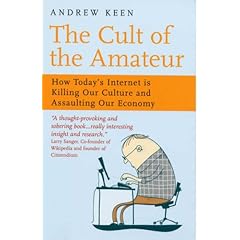
Book: The Cult of the Amateur

I just finished reading Andrew Keen’s The Cult of the Amateur, a highly provocative and controversial book that argues that the net’s user generated content is in fact destroying our culture.  Keen decries everything he believes to be wrong with the Web 2.0 which is namely the mediocre work of amateurs:

… democratization, despite its lofty idealization, is undermining truth, souring civic discourse, and belittling expertise, experience, and talent. As I noted earlier, it is threatening the very future of our cultural institutions. I call it the great seduction. The Web 2.0 revolution has peddled the promise of bringing more truth to more people—more depth of information, more global perspective, more unbiased opinion from dispassionate observers. But this is all a smokescreen. What the Web 2.0 revolution is really delivering is superficial observations of the world around us rather than deep analysis, shrill opinion rather than considered judgment. The information business is being transformed by the Internet into the sheer noise of a hundred million bloggers all simultaneously talking about themselves.

Moreover, the free, user-generated content spawned and extolled by the Web 2.0 revolution is decimating the ranks of our cultural gatekeepers, as professional critics, journalists, editors, musicians, moviemakers, and other purveyors of expert information are being replaced (“disintermediated,” to use a FOO Camp term) by amateur bloggers, hack reviewers, homespun moviemakers, and attic recording artists. Meanwhile, the radically new business models based on user-generated material suck the economic value out of traditional media and cultural content.

Keen is an excellent and engaging writer and whilst I dont actually agree with his views I did find them interesting, thought provoking and quite entertaining. I have to be honest, his over the top vitriol against the collaborative and distributed nature of the content generated on the internet in this Web 2.0 world, is at times so over the top that I couldn’t help but laugh.

Keen does raise some very important points about intellectual property, authenticity, authority and even identity and whilst its easy to dismiss some of his vitriol as the rantings of a self proclaimed (although  he was being sarcastic at the time :p ) “disgraceful fascist luddite communist control freak monarchist failed dotcom entrepreneur” ,you can’t dismiss the fact that some of concerns he raises are not only valid but deserve thought – even if you have to dig to see it! 

I also took the time to read one of the articles Keen wrote for the Washington Post in which he likens the promise of Web 2.0 to Marx’s promise of Communism …

Just as Marx seduced a generation of European idealists with his fantasy of self-realization in a communist utopia, so the Web 2.0 cult of creative self-realization has seduced everyone in Silicon Valley. The movement bridges counter-cultural radicals of the ’60s such as Steve Jobs with the contemporary geek culture of Google’s Larry Page. Between the book-ends of Jobs and Page lies the rest of Silicon Valley including radical communitarians like Craig Newmark (of Craigslist.com), intellectual property communists such as Stanford Law Professor Larry Lessig, economic cornucopians like Wired magazine editor Chris “Long Tail” Anderson, and new media moguls Tim O’Reilly and John Batelle.

You don’t have to like his views or even agree with them, but it would be a mistake to ignore them entirely. For that reason I think the  The Cult of the Amateur is a valuable text that will hopefully spur on some constructuve debates within the Web 2.0 community. 

Peter Morville talks to Talis

Last month I talked about Peter Morville’s tech talk over at Google about his new book Ambient Findability. Well last week Peter was interviewesto one of my colleagues here at Talis, Richard Wallis, about his book and his views on Web 2.0, information architecture, authority and a number of other issues you can listen to the podcast here…


Download MP3 [40 mins, 36Mb]>