
The Quake Army Knife multigame developer toolkit is now available for download. With this new version you now have OpenGL support in the QuArK Map and Model Editors. For a full description of the new features and to download the toolkit visit The Official QuArK website.
Category Archives: Technology
Installing IE6 and IE7 on One Machine … well kind of.
I’ve been playing around with testing some changes to the user interface for our Project Cenote research prototype. Unfortunatly the new IE7 update was rolled across all the machines at work and it means I cant test to see how the changes I’m playing with look or even work in IE6. Anyway I tried to look around to see if it was at all possible to have both version of the browser running on a single machine – and thats when I came across an interesting article by Jennifer Kyrnin entitled How to install two version of IE( IE6 and IE7) on One Machine.
I was a little disappointed though I guess I was kind of hoping for a solution that didnt involve creating a Virtual Machine. The article does tell you exactly how to get two versions of IE working on the One Machine, however the only way to get it to work is to use run a Virtual PC running an instance of Windows XP that has IE6 installed in it. That way your native PC has IE7 and you can flick to your VPC to test pages with IE6. Its an excellent little tutorial and well worth a read if you need to get around the problem. I prefer VMWare over VPC and I guess I’ll get our wonderful support team to set up a VMImage running WinXP for me without the IE7 patch but still ….
I do get a bit frustrated at the fact that I cant simply choose to install IE7 without loosing the ability to use IE6 … but that would probably mean that Microsoft would have to seperate their browser from the OS – of which its still seamingly an integral part.
Oh well its a good thing that IE isn’t the only browser out there … did I mention how much I really, really like Firefox! It’s totally free, you can run more than one version on a single machine, and its still much better rounded and far more extensible than IE.

SearchMash, Google Spreadsheets and Google Docs updated
Looks like Google have been busy. Theres been major updates to Google Spreadsheets and Google Docs. You can access both at docs.google.com using your GMail account. In addition to being able to create documents and spreadsheets using Googles new online editors you can also upload documents in MS Word, OpenOffice, RTF, HTML and Text. Once you have created your document you can download it to your desktop in any of the above formats. The same is true of Google Spreadsheets. You can also invite other users to share your documents online. Finally you can now publish your online documents and spreadsheets directly to your blogs!

SearchMash is Google’s new web search interface, just without the Google branding apparently in an attempt to ensure impartiality amongst test users. The new search interface boasts some cool features – integrating web search, images, video, blog and Wikipedia searches all into one dynamic page with modules that expand and collapse. I really do like it … it aggregates results from several sources onto one easy to use screen. Try it for yourselves.
Gordon Ramsay could teach software engineers a thing or two?
Rob and I took a coffee break from refactoring some code yesterday and he asked me if I had watched Ramsay’s Kitchen Nightmares the night before, which I had! We commented on how formulaic the show is – each episode Ramsay turns up at the door of an ailing restaurant, and helps get them back on track and making money by empowering and motivating the cooks, using fresh ingredients, coming up with a simple less complicated menu, keeping management out of the kitchen and in the front where they belong, and above all putting the customer first!! Rob then said something along the lines of “You know when you think about it its not too different to the problems that many other software engineering firms face“. That’s when the penny dropped …
As a metaphor this should sound familiar to anyone working on a large ( even not so large ) software project. Your coders are the equivalent of your kitchen brigade, guys and girls who have to deliver, without them you cant serve anything to your customers. Your ingredients are API’s, frameworks, and technologies. Your complicated menu’s are over analysed, over designed, and over complicated software architectures; and lets not forget your restaurant managers are the same as your project managers, who generally know sod all about writing code, they promise your customers everything under the sun, generally work their brigade to death to deliver to unrealistic time frames and have a penchant for blaming the coders when it all goes tits up!
Worst of all the customer rarely gets what he or she actually ordered, because so many software company’s still persist on following dated project management and development methodologies trying to gather requirements up front, do exhaustive analysis and design then coding, and finally delivering a system 12 months later to a customer who’s requirements have now changed.
Did I sound bitter then? It’s probably because I realise that I’ve spent the better part of a decade working for the kinds of software companies where this kind of thing is considered the norm. Sadly for many company’s it still is the norm!
So lets apply the Ramsay formula to this. How do you turn teams that are building software in the manner above around?
Firstly, you have to empower your brigade. In the past I’ve worked in places where the job of most developers is simply to “fill-in-the-blanks”… in other words just implement method stubs that are generated by a design tool that the architects use. This creates hierarchical divisions within teams, and is generally extremely de-motivating. Like a cook who has given up using his imagination, has no passion, and has given up thinking creatively and has been reduced to doing little more than reheating pre-cooked frozen hash.
In order to empower the team, they need to OWN the code collectively. It doesn’t belong to one person, it belongs to everyone. As a team they’re passionate about it. You have to be break people out of the traditional thinking that I wrote this class so people have to check with me if they want to change it!
We need “fresh” ingredients. Yes we should re-use software but only if its appropriate. How many times have you worked on software projects where the architecture isn’t based on whether its the right technology or tool for the job, but is based on other factors like the company you work for has a cool licensing agreement with a vendor and wants to use their technology because they don’t have to fork out for something more appropriate? This, using a square-peg to fill a round hole approach, in variably leads to difficulties.
Have “simpler menus”! We need to get rid of up-front complicated over-architected designs, and over analysing solutions – which are a product of old-style waterfall approaches. Teams need to be moving towards iterative, agile development methodologies. These processes engage the customers who are able to provide feedback on the product at the end of each iteration so this approach to developing software encourages customers to change their requirements if and when they want to which means that when you finally deliver … your actually giving them what they want! And this squarely puts the customer first!
Keep management out of the kitchen. If your the kind of organisation willing to invest in bringing a smart bunch of technical people together, then trust them to do their job. They don’t need project managers standing over their shoulders asking them for an hourly update on their progress. This kind of Orwellian micro-management is culturally ingrained into some large software companies and in my opinion it is very, very damaging. It fosters resentment, encourages bullying and totally de-motivates developers because of the perpetual monkey on their backs!
I am so glad im not working for an organisation that suffers from these problems, and perhaps if you are then maybe you should consider a change?
Enemy Territory Quake Wars- Running on new NVIDIA GeForce 8800 GPU
Todd Hollenshead from idSoftware was on hand at the launch of the new NVIDIA GeForce 8800 GPU, as part of the launch he showed off never before seen gameplay footage of this new game running on the new hardware … and it looks absolutely stunning! Watch it for yourselves here.
Oh and this isnt rendered CGI, its actual in game footage.
OLPC – One Laptop Per Child Video Tour
Was very impressed when I saw how far the OLPC project had come, this demonstration of the user interface on this Linux based laptops is simple and intuitive and a world apart from the bare Linux interfaces most of us are used to. You can also learn about the history and some of the issues faced by the project on Wikipedia, as well as view official information at the OLPC Homepage. The laptops are will cost $100, and a represent an opportunity to revolutionise how we teach the worlds children – with an emphasis on developing nations where access to technology is limited for under privileged children.
Oh and did I mention that they are wind-up powered??
Japanese Develop Umbrella with Flickr and YouTube Integration
This made me smile:
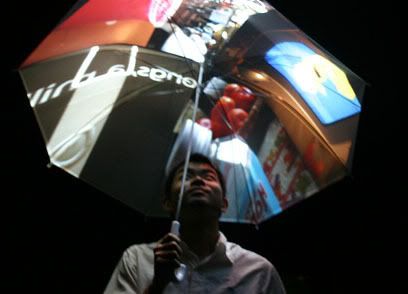
Some scientists at Tokyo’s Keio University have developed a brolly with a digital camera, WiFi, and a projector built-in. They’re calling it “Pileus“. It can be used to capture images as well as video while your out and about ( in the rain 😉 ) which are then sent to Flickr and YouTube. Plus you can beam previously captured images and video down onto the ground using the built in projector.
Read a bit more about the umbrella here
Microsoft Labs – Photosynth
I’ve been playing with Photosynth over at Microsoft Live Labs. My first reaction was … wow! Every now and again you come across something that makes you sit up and ask how the hell did they do that? The demo bascially takes a number of images of an object or a place and creates a scene, which is a detailed 3D model that gives the user the sensation that he or she is “flying” around the model.