Chicken Pilau Rice with Peas

As a follow up to the Mutton curry recipe I posted last week I promised a few friends I’d post up a recipe for making Chicken Pilau Rice with Peas which is often served with Mutton Curry in Pakistani/Kashmiri households. Many of my friends who have been round to my place or mom’s will have eaten this and im hoping they will be able to follow this recipe for themselves ( yes Alan, I mean you! :p ).

Chicken Pilau Rice with Peas
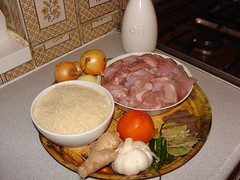

Ingredients

  • 2lb Boneless Chicken Leg cut into 1 inch pieces
  • Basmati Rice, approx 4 large cups
  • 1 Cinnamon Sick
  • 4 Large Cardomen pods
  • A couple Small green chillies
  • 1 large red tomato
  • Tablespoon of grated ginger
  • tablespoon of finely chopped garlic
  • 6 small sized onions
  • 1 teaspoon of cumin seeds
  • 4 bay leaves
  • butter
  • sunflower oil

Method

  • Pour sunflower oil into a large cooking pot, pour enough oil to cover the base of the pot. Add butter to this, I normally use about a quarter of a small block of unsalted butter. Put the heat on relatively low and melt the butter into the oil.
  • Add the cardomen, cinnamon, bay leaves and cumin to the pot and stir into the oil. Turn the heat up a little but not too high. You want stir these aromatics into the mixture for a couple of minutes.
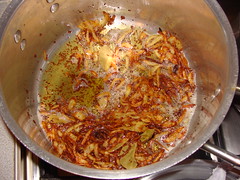
  • Slice the onions fairly coursely, and add to the pot along with the chillies, grated ginger and the garlic. Stir into the mixture until the onions are golden and crispy, this can take about 5 to 10 minutes, dont be tempted to turn the heat up if you do you’ll end up burning the onions, you want them golden and caramelised – as pictured.
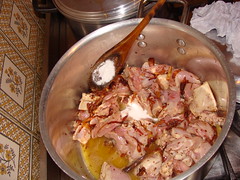
  • Once the onions are done, add the diced chicken to the pot and stir into the mixture, try to make sure that you coat all the chicken evenly with the oil and onions. Also at this point add a tablespoon or so of salt, and stir in. You need to keep the chicken moving in the pot so it doesn’t stick to the bottom, but don’t stir it too aggresively, just work it gently until its golden brown. The chicken will also release its own natural liquids so you’ll end up with a lovely golden colored gravy coating the chicken. Again do not turn the heat up high, the trick is to be patient and just let it take as long as it takes. If you try to force it by turning the heat up, it will all go horribly wrong.
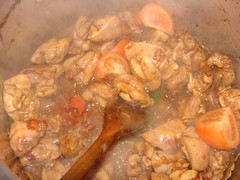
  • When the chicken takes on that lovely golden coating and the mixture looks like its reducing nicely, chop your tomato into quarters and add to the pot. As pictured. By the time the mixture reduces completely the tomato will have completed dissolved and disappeared.
  • Once it’s reduced add the frozen peas to pot. Because they are frozen they too will shed a some liquid, just stir them in for a couple of minutes. Then you need to add boiling water to the pot. You need to add enough to cover the chicken and peas completely. Allow this simmer gently for about five minutes.
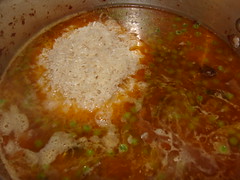
  • Whilst thats simmering you need to wash your rice in cold water. Rice contains lots of starch and you need to wash it out basically until the water runs clear. I do it by placing the rise in a bowl of cold water then rinsing through a collinder, and repeating that until the water is clear. Once the rice is washed add it to the pot and stir in. You then want to cover the pot and place into a hot oven (220 deg C ) for about 45 minutes, and leave it alone. It’s not a bad idea to check on it at around the thirty minute mark if you’re nervous about burning it. Usually 45 minutes is enough.

After 45 minutes remove the pot from the oven. The rice should be cooked beautifully, and the aromatics you added early on will have infused the rice so it’ll have the wonderfully pungent spicy aroma. You can serve the rice with the mutton curry.

As with the last recipe I have uploaded detailed photos with instructions into a set on flickr. Enjoy!

BTW: for all those vegetarians out there, you can substitute the chicken for Chick Peas which also works really well.

Update: I’m tagging a couple of people so that they’ll hopefully post up some recipes:

Geppeto: Consumer’s Approach to Programming

ABSTRACT

Contemporary society is experiencing a steady stream of new electronic gadgets, software products, and web applications. In this flood of functionality, users have adapted to rely less on manuals (if they are present at all) and shift their learning to trial and error, common paradigms, and experimentation. To accommodate this style of use — or perhaps driving this behavior – developers have successfully abstracted much of the technological complexity and transformed it into intuitive user interfaces often avoiding the need for reading lengthy manuals and formal training. Is it possible to adopt the same trial-and-error experimentation habit not only for using gadgets, but also for application development? We claim that intuitive aggregation and combination of software gadgets makes this possible.

In this talk, we will show the use of current technology in building a consumer oriented development tool appropriate for individuals not formally trained in programming. We demonstrate that the complexity of existing system and scripting languages i.e.; syntax, semantics, control and data flow, data structures, data types, and programming components can be successfully replaced with analogies intuitively accessible to a much wider consumer population based exclusively on their use and understanding of user interfaces in popular web applications. We present a demo of Geppeto — a consumer tool for gadget-based application development. Composing gadgets with Geppeto does not require programming experience or reading of convoluted manuals. The presented research is sponsored by Google Inc. and the Croatian Ministry of Science.

Intelligence in Wikipedia – Bootstrapping the Semantic Web

ABSTRACT:
Berners-Lee’s vision of the Semantic Web is hindered by a chicken-and-egg problem, which can be best solved by a bootstrapping method: creating enough structured data to motivate the development of applications. We believe that autonomously `Semantifying Wikipedia’ is the best way to bootstrap. We choose Wikipedia as an initial data source, because it is comprehensive, high-quality, modestly sized, and contains enough manually-derived structure to bootstrap an autonomous, self-supervised process.

Mutton and Potato Curry

In response to being tagged by Rob, I’ve decied to share a family recipe. This is a not so traditional way of making a curry that is a staple in any Pakistani/Kashmiri household. A few years ago my sister, Salma, who is a far better cook than I am, showed me an easier way to make a curry than the traditional method I learned as a youngster. Her method results in the same exceptional flavours and tastes but the early stages don’t feel quite so laborious (no burning/toasting spices etc. ). I was quite amused as I jotted down notes while making this dish, I’ve done it hundreds of times and yet never thought about it. In fact writing out a recipe just feels wrong! I never learned to cook this by following a recipe, I learned by watching my mother cook when I was a kid, it’ bloody hard trying to quantify the amount of ingredients or spices since I just normally do it by instinct – something my sister didn’t hesitate to comment on by saying:

Your instructions will be hard to follow, why do you want to write it as a recipe on a stupid website, it’s easier to invite you friends round and just show them how to make it, by cooking it for them.

I’m hoping some of you prove her wrong, else I’ll have to start inviting people round, as a matter of honour!

Mutton and Potato Curry ( serves 4-6 )


Ingredients

  • Diced Mutton Shoulder (2lb)
  • 4 medium sized onions
  • 6 cloves of garlic
  • Table Spoon of grated Ginger
  • 1 Red Pepper
  • 1 bunch of Corriander
  • 1 bunch of Methri ( Fenugreek )
  • Half a dozen small green chillies
  • 4 table spoons of Sunflower Oil
  • A cup full of Passata
  • Curry Powder
  • 1 teaspoon ground Corriander
  • 1 teaspoon of Garam Masala
  • 1 teaspoon ground cumin
  • A dozen small new potatoes
  • One jug of cold water
  • Salt
  • Pepper

Method

  • Start off by chopping up onions into either a rough dice or fairly course slices. Also chop up the chillies and the garlic and place in a large cooking pot. Grate the ginger into the pot it’s up to you how much use, as is the case with garlic and chillies, these amounts reflect how much I normally use when cooking 2lb of Mutton. Add the meat to the pot. Also add 2 tablespoons of curry powder ( or less if you dont want it too hot ), add the passata, the sunflower oil, some salt and pepper. Stir the pot well making sure the meat is covered evenly by the passata, oil and curry powder.
  • Place the pot on your cooker and turn the heat all the way up! ( trust me! ) cover the pot with a lid and leave it there for a few minutes. What should happen is that as the heat quickly builds up in the pot the meat will start to release its own liquid and juices and within about five minutes if you take the lid off you should see theres enough liquid to almost cover the meat, without you having to add any extra. At this point chop and add all the corriander stalks you have to the pot, and stir. Then cover, ensure the lid remains on, and the heat high for about a quarter of an hour. Then take the lid off and stir well before, replacing the lid and simmering on a low heat for about 40 minutes. During this period you might want to stir the mixture a couple of times to ensure it doesn’t burn or stick to the bottom.
  • After forty minutes the meat should be tender(, if it isn’t you might want to add some water, bring to the boil and continue to simmer until it is tender). With the meat tender, remove the lid and turn the heat up. You need to continuously stir to prevent the mixture sticking to the pan and burning since you need to completely dry it out. You’ll know you are done when the oil has completely seperated from any residual liquid and the meat with its viscous spicy coating takes on a dark color. Also at this stage the onions and other ingredients you added should have completely dissolved and disappeared into the mixture.
  • Chop up and add the fenugreek, also add the ground corriander and the garam masala at this stage and stir well into the viscous mixture.
  • *Note: This used to be stage of cooking where, as a kid, I’d sneak into the kitchen and pick out a piece of meat, put a sprig of corriander on it and pop it into my mouth before my mom caught me. The explosion of spices with the corriander will blow your head off if you aren’t used to hot spices but it tastes divine. By the way the process of stirring and drying out all the liquid is what we refer to as ‘Bhuna’, if you’re ever in an Indian/Pakistani/Kashmiri restaurant and you see a ‘Bhuna’ dish on the menu it’s effectively a curry served at this stage.

  • With the bhuna dry and the spices mixed in, add the potatoes and stir in.
  • Cover the entire mixture with a jug of water, and bring to the boil. Leave it boiling for about 5 – 8 minutes. Then simmer on a medium heat for a further 15.
  • After simmering add all the chopped up corriander leaf and stir in. Also sprinkle the cumin on and either leave it to rest, or leave it on a very low heat. At this point you are ready to serve, which you can do so with rice or chappati’s.


Done!

Given that my instructions might not be the easiest to follow :p I took a load of pictures as I was cooking this and have posted them, with captions, in a set, on flickr!

Hope you enjoy it!

Shoot: Avalon November 2008

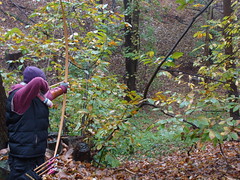
Last weekend Richard and myself and other members of Kings Norton Traditional Archers took part in the Avalon shoot. It was a 40 target shoot, all 3D’s!! We all had a really good time. Phil, the youngest member of our club, did exceptionally well shooting from Adult pegs, and won a medal at the end of the day. I had a pretty mediocre first half scoring 200 but in the second half I scored well over 300 which only served to irritate me when I realised that if I had shot as well in the first half I’d have probably won something too! Regardless of that though it was a really well laid out course and great fun to shoot. As always I have uploaded photo’s from the day to flickr, below are a couple of snaps.

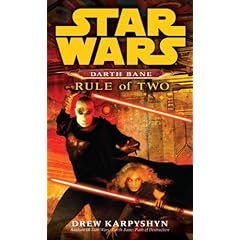
Darth Bane: The Rule of Two

Just under two years ago I read and reviewed Darth Bane: Path of Destruction, which I thoroughly enjoyed. I remember at the time hoping that Drew Karpyshyn would write a sequel. I felt that Bane was an incredibly well realised character and one that the reader is drawn to and serves to illustrate that good and evil aren’t necessarily absolutes. A couple of weeks ago I was pleased to learn that a sequel had been released so I bought a copy and read it in the space of two evenings.

Darth Bane: The Rule of Two continues where the previous book ended. Darth Bane is now the Dark Lord of the Sith after destroying the entire Sith order who had united under the banner of The Brotherhood of Darkness. In Bane’s eyes The Brotherhood of Darkness with it’s emphasis on equality was a perversion of the true ideals of the Sith and had to be destroyed so the Sith order could be rebuilt based on it’s oldest law. As the last surviving Sith Darth Bane promulgated a harsh new directive: The Rule of Two:

  Only two there should be; no more, no less.
     One to embody the power, the other to crave it.

At the beginning of the book, after Brotherhood have all been destroyed by a thought bomb, Bane comes across a young ten year old girl who is sensitive to the Force, and who in a fit of rage kills two Jedi. Though she is young Rain possesses an instinctive link to the dark side that rivals his own. Bane is impressed by her power and takes her as his apprentice: Darth Zannah. With his guidance she will become essential in his quest to destroy the Jedi and dominate the galaxy.

It’s a wonderfully entertaining book, that captivates from beginning to end. We learn more about Bane and his ambitions and his quest for greater knowledge and power. We watch as he continuously tests his young apprentice and we are not only drawn into his scheming but also into hers. This serves to constantly remind the reader that the essence of the Rule of Two is that the Apprentice will one day grow stronger or more cunning than his/her own master and on that day must kill the Master, assume the mantle of Dark Lord of the Sith, and find an apprentice to train in the ways of the Dark Side.

I wont reveal much more of the plot but I will recommend this book, as a great bit of fun reading … also I really hope there is a follow up since Bane’s story definitely does not end with this book.

Marcus Aurelius

Been reading a lot this weekend, it’s the only form of escape I can turn to without relying on any form of planning. I’ve got a couple of book reviews to write but I thought I’d post up some passages I just read by Marcus Aurelius which seem relevant right now for a number of reasons that I don’t intend to elaborate on …

All things are linked with one another, and this oneness is sacred; there is
nothing that is not interconnected with everything else.  For things are
interdependent, and they combine to form this universal order.  There is
only one universe made up of all things, and one creator who pervades
them; there is one substance and one law, namely, common reason in all
thinking creatures, and all truth is one--if, as we believe, there is only
one path of perfection for all beings who share the same mind.

… and …

Why should anyone be afraid of change?  What can take place without it?
What can be more pleasing or more suitable to universal Nature?
Can you take your bath without the firewood undergoing a change?
Can you eat, without the food undergoing a change?  And can anything
useful be done without change?  Don't you see that for you to change
is just the same, and is equally necessary for universal Nature?

… and also …

Discard everything except these few truths:  we can live
only in the present moment, in this brief now; all the rest
of our life is dead and buried or shrouded in uncertainty.
Short is the life we lead, and small our patch of earth.

… and finally …

nowhere can a man find a quieter or more 
   untroubled retreat than in his own soul

our circle of compassion

A human being is a part of the whole called by us universe, a part limited 
in time and space. He experiences himself, his thoughts and feeling as 
something separated from the rest, a kind of optical delusion of his 
consciousness. This delusion is a kind of prison for us, restricting us to 
our personal desires and to affection for a few persons nearest to us. 
Our task must be to free ourselves from this prison by widening our 
circle of compassion to embrace all living creatures and the whole of 
nature in its beauty.
                -- Albert Einstein

Zimbardo, Lewis and Donne

I’ve been reading Philip Zimbardo’s – The Lucifer Effect, which is proving to be very difficult to read. Someone described it as a ‘transformative text‘ and I completely agree with that sentiment. It’s impossible to read without reflecting deeply about oneself. From what I’ve read so far If I had to distill Zimbardo’s book into a single sentence it would be that situation plays a bigger part in determining evil or heroic behaviour than any innate disposition.

That sounds so simple and yet it’s so very complex. I intend to write a review of the book when I’m finished but for now I’ve been reflecting on some material that Zimbardo points to. The first is “The Inner Ring” by C.S. Lewis, which from what I can gather was a Memorial Lecture at King’s College, University of London, in 1944.

In it Lewis describes one such situational imperative that can drive people to make abhorrent decisions. Many Organisations (all?) have groups of people who are more powerful or influential than others. This is true whether the organisation is a company or a less formalised social group. These so called “rings” admit some people and exclude others. The desire to be inside, to gain acceptance and approval, can be a powerful motivational force for some people, and conversely this desire can be used by those on the inside to manipulate those seeking admission. As Lewis himself describes:

I believe that in all men's lives at certain periods, and in many 
men's lives at all periods between infancy and extreme old age, 
one of the most dominant elements is the desire to be inside the 
local Ring and the terror of being left outside ... Of all the passions 
the passion for the Inner Ring is most skilfull in making a man who 
is not yet a very bad man do very bad things.

We have to recognise, individually, that we are all susceptible to such forces, they are after all a part of the human condition. The problem is many of us aren’t willing to acknowledge this, as Zimbardo points out, our unfounded pride takes precedence over what should be the humility to recognise that we are all vulnerable to such situational forces. In his book Zimbardo recalls John Donne‘s Mediations (27), as a wonderfully eloquent reflection on our common interrelatedness and interdependence, which I think is absolutely key to guarding our hearts and minds against such behavior:

All mankind is of one author, and is one volume; when one man dies, 
one chapter is not torn out of the book, but translated into a better 
language; and every chapter must be so translated...As therefore the
bell that rings to a sermon, calls not upon the preacher only, but 
upon the congregation to come: so this bell calls us all: but how much
more me, who am brought so near the door by this sickness....
No man is an island, entire of itself...any man's death diminishes me, 
because I am involved in mankind; and therefore never send to know
for whom the bell tolls; it tolls for thee

Zimbardo’s book is proving to be a challenge on many different levels. The graphic nature of some of the experiments he describes, as well as some of the atrocities he has researched is painfully disturbing to read. Man’s lack of humanity is central to Zimbardo’s thesis, and on that subject I can’t help but smile ruefully thinking that Tennessee Williams was probably right when he wrote:

We're all of us guinea pigs in the laboratory of God. 
Humanity is just a work in progress

I’d love to hear anyone else views on the book or the subject, I’m learning a great deal as I read it but I’d welcome anyone else insight. So please leave a comment or get in touch.