
Requiem From The Darkness

I finished watching the series Requiem From The Darkness this evening. It’s easily one of the most disturbing series I think I’ve ever seen, even for an anime! The series comprises of thirteen episodes which are roughly half an hour long each, and absolutely not for the squeamish or feint of heart.

Brief synopsis
Towards the end of the the Edo Period, Momosuke, the son of wealthy merchants turns his back on his family’s profession and decides to become a writer. He comes up with the idea of of writing a collection of stories about the mysterious and the supernatural. After a chance encounter with a monk and his strange associates on a snowy mountain Momosuke is drawn into a world of darkness he can scarcely begin to imagine. Momosuke travels with the trio who have sworn to cleanse the land of corruption: Mataichi, the mysterious monk; Nagamimi, a massive figure who is seemingly a master of disguise; and the beautiful bt deadly Ogin. This trio of strange characters travel the countryside dispensing their own form of karmic retribution on the truly evil.

Review
The very first thing you notice about this series is it’s very unusual and unique visual style. For instance the character are drawn in wildly different styles. The four main protagonists are drawn in a in a rather traditional anime style, but all other characters that are tangential to the story are drawn in a very surreal manner – with almost grotesquely proportioned bodies, enlarged heads, and often missing facial features. This gives the series a very creepy feel. It’s not just the characters, the sky is often a strange purple color, and for some odd reason lakes appear red in this world.

As for the story – the series tries to examine human psychology. Whilst the supernatural does feature in this, it’s the all too real corruption of humans that is central to this – moral and ethical corruption and how it effects people is really what this series is trying to explore. It raises many questions not least of which is the morality of the three outlaws and their method of punishing the criminals, which are truly disturbing at times. Of course so too are the crimes that they are punishing which include incest, murder, witch craft and even cannibalism. Which is why this series complete deserves the 18 certificate it has. Whilst there are sexual themes, there is nothing gratuitous, in fact the same is true of the violence which is also often implied, but the atmosphere the series creates is what drives you to imagine the worse, when you are left to fill in the blanks. It does make you jump at times, and on a couple of occasions made me feel nauseous!!

I have to admit that I enjoyed this series! But that being said I must also confess that even I struggled with the nature of some of the themes it explores. So be warned!
Nature brings Solace …

I’ve been having a wonderful weekend. It’s always nice to get away, although in fairness the Warwickshire countryside isn’t necessarily that far away, still not every journey should be measured in terms of physical distance. I woke up pretty early this morning, like many people I totally forgot the clocks went back an hour last night. I tend to be restless when I wake so I got up and decided to take in the view. It’s stunning here. I don’t know what it is about the countryside, about being away from the city that I find so calming. I experienced something similar a couple of months ago when Richard and I went to Devon for an eight day Archery shoot, a trip that helped me to confront certain things I guess I’ve been hiding from.

Sitting on this balcony this morning gazing across the country side, as is often the case, I was absorbed by my own thoughts. Isn’t it strange and yet wonderful how the mind can meander from one thought to another and then suddenly present you with an answer or an insight from the deepest recesses of your memory. That’s how I was reminded of something that Anne Frank wrote, and I think it echoes my own feelings right now:

The best remedy for those who are afraid, lonely or unhappy is to go 
outside, somewhere where they can be quiet, alone with the heavens, 
nature and God. Because only then does one feel that all is as it should 
be and that God wishes to see people happy, amidst the simple beauty 
of nature. As long as this exists, and it certainly always will, I know 
that then there will always be comfort for every sorrow, whatever the 
circumstances may be. And I firmly believe that nature brings solace 
to all troubles.

Shoot: Seven Valley Yeomen Foresters – Oct 2008

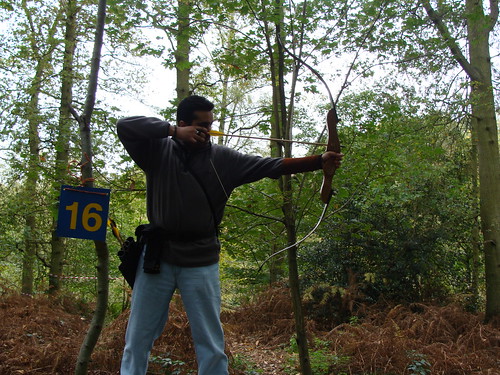
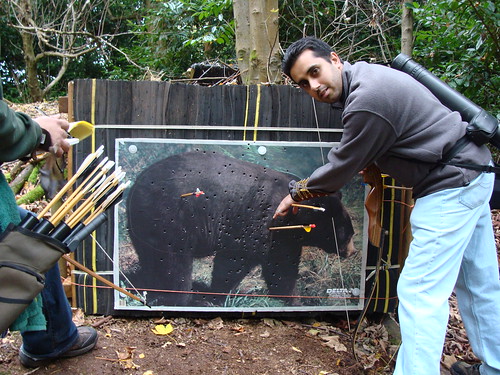
Had a great day today, everyone in Kings Norton Tradition Archers took part in S.V.Y.F ‘s second annual shoot in Ombersley, near Droitwich. As always the shoot was wonderfully organised and this event comprised of 36 targets, a mixture of 3D’s and 2D paper faces. I shot with four archers from Robin Hood Longbow: Dave, Nigel, James and Andrew who were a lot of fun to shoot with. I thoroughly enjoyed the day! I’ve uploaded my photos from the day to flickr here. Here’s a couple of me:


Yay! got an inner kill!

Proverbs 11:29

I’m thinking that we should all remember the wisdom of Solomon in the Book of Proverbs:

  He that troubles his own house shall inherit the wind: 
     and the fool shall be servant to the wise of heart.

The phrase “own house” could easily be substituted with any (social?) group an individual belongs to: your friends, your family, a sports team, your colleagues at work, your country and so on. The tragedy is that it’s difficult to see when we are falling foul of this, because it really doesn’t take much. It seems to me that when one believes one is right it’s easy to become rigidly inflexible, it’s easy to lack consideration for the feelings of others, or indeed to dismiss them out of hand out of sheer frustration with the other rather than taking a step back and questioning one’s own standpoint. Worse is that it’s easy to overlook the immediate damage this can cause to relationships, to how people perceive you, and of-course their willingness to want to engage with you. It seems to me this should be interpreted as a serious lapse in judgment in any of us, and near fatal lapse in judgment for anyone in a position of authority/leadership; it tends to undermine trust by creating distance; it’s becomes a barrier to any constructive dialogue; and those around you can lose their voice. When that happens you have, quite literally, inherited the wind.

Part of the problem is that we are deeply emotional creatures, and we wear those emotions like a cloak around us. Something I’ve observed often is that even when an individual is putting forth an argument in a manner that he/she might feel is objective, concise, erudite and wholly reasonable, their body language, or language, or tone, or even a slight unconscious inflection when uttering a single word, can send out a completely different message. It’s this dichotomy that we create that puts us at odds with those observing us, those that we are trying to communicate with.

It’s actually quite amusing to observe when this happens during the current political debates taking place between the candidates in the American Presedential election. That’s not really not what I want to talk about though.

So I guess the question becomes, how do we guard against this? How do I know when I’m doing this? It shouldn’t be a paradox because in as much as we are emotional creatures we are also hugely perceptive creatures. Yet it becomes a paradox when you ask what is it about our emotions that seemingly overrides our ability to perceive the effect our words and actions have on others? or worse, what is it that overrides the need to perceive the effect we have on others – until the damage is already done?

Is it something that we can guard against by simply thinking or taking a moment to pause before speaking/reacting? Is this a quality that can be taught? or is this simply something we have to learn in the crucible of our own minds as we reflect on each time we make this mistake? or should we simply temper what we do with the knowledge that we are part of a (social) group and that our behaviour will reflect how much we are accepted and valued, or indeed, rejected by that group?

As an observation this is something I’ve learned the hard way, for me it was brought into sharp relief when my father died. Fortunately, as social groups go, families are rather more forgiving than others 🙂

"The universe speaks in many languages, but only one voice ... 
It speaks in the language of hope."

"It speaks in the language of trust. It speaks in the language of 
strength and the language of compassion. It is the language of the 
heart and the language of the soul. But always it is the same voice.
It is the voice of our ancestors speaking through us and the voice 
of our inheritors waiting to be born. The small, still voice that says: 
'We are one. No matter the blood, no matter the skin, no matter the 
world, no matter the star. .. We are one. No matter the pain, no 
matter the darkness, no matter the loss, no matter the fear. .. We 
are one.' Here, gathered together in common cause, we begin to 
realize this singular truth and this singular rule that we must be 
kind to one another. Because each voice enriches us and ennobles 
us and each voice lost diminishes us. We are the voice of the 
universe, the soul of creation, the fire that will light our way to 
a better future. We are one."
   
           G'Kar in "The Paragon of Animals"

Paradox of Life

        Paradox of Life
     by Sunday B. Fakus

True love, like tree branches,
Brings fruits in its due season.
Lofty trees of barren leaves
Is love that has nothing to give.

Secret love, like hidden treasures,
Has worth- when it's ripe.
A thousand words of empty promises
Is hope that has nothing to yield.

Shattered dream, like broken hearts,
Takes away the joy of life.
Every love that a liar gives
Is nothing but a gate of grief.

A restless heart, like raging winds,
Rubs the mind of all its peace.
Silent pain of a lonely soul
Is worse than worries of hopeful lovers.

SVN: Useful bash commands

Here’s a couple of useful bash commands I’ve been using recently when working with Subversion:

The first helps me with an annoyance I have with externals. Normally doing a “svn st –ignore-externals” still lists all the externals even though I’m not actually interesting in seeing them when I want to know what I’ve changed locally. For example in the output below I only really want to know that I’ve changed ‘development-tenants.xml’, i’m not really interested in the rest.

Nadeems-Computer:zephyr-trunk nadeemshabir$ svn st --ignore externals
X      lib/arc
X      lib/moriarty
X      lib/simpleSAMLphp
X      3rdPartyDevelopmentTools/svnant-1.0.0
X      3rdPartyDevelopmentTools/PHPUnit
X      3rdPartyDevelopmentTools/selenium-server-1.0-beta-1
X      3rdPartyDevelopmentTools/selenium-core-0.8.3
M      developmentdata/development-tenants.xml

To address this the first command is an alias I’ve created that shows me all the files that I’ve changed/added/removed locally but specifically doesn’t list anything related to any externals

alias whatschanged='svn st --ignore-externals | grep -v "^X "'

The second bash command deals with the fact that I often have a large number of files I want to add to subversion all at once. This command takes all un-added files and adds them to subversion …

svn st | grep '^? ' | awk '{ print $2 }' | xargs svn add

Hope you find them useful.

Mongol: The Rise To Power Of Genghis Khan

Finally got round to watching Sergei Bodrov’s visually stunning Mongol – The Rise To Power Of Genghis Khan. The movie is a sweeping epic that is rumored to be the first part of a trilogy that Bodrov is making about the Mongol ruler. In this film though Bodrov focuses on the life of the young Temudgin and his ascent to power.

When his father is poisoned and his lands and posessions taken, Temudgin flees from his father’s rivals. He is saved by a young prince, Jamukha, and the two become blood brothers. Later that bond of friendship is tested, though, when the grown Temudgin wages a war, in violation of the Mongol code, to win back the captive wife Borte. As Temudgin asserts his own power, he must also face Jamukha in all-out battle if he is to secure the safety of his family. The movie offers a unique look at the influence of love and loyalty to the life and times of one of history’s most renowned rulers.

This film isn’t historically accurate and is very much a revisionist account of the early life of the enigmatic Genghis Khan. This fact didn’t make the movie any less captivating, or enjoyable. It is a gorgeously shot epic, with beautifully composed landscape shots punctuated by thundering hooves and bloody, slow-motion battle sequences.

Definitly worth watching!

Not so random thoughts …

G'Quan wrote: 'There is a greater darkness than the one we fight. 
It is the darkness of the soul that has lost its way. The war we fight 
is not against powers and principalities, it is against chaos and despair. 
Greater than the death of flesh is the death of hope, the death of 
dreams. Against this peril we can never surrender. The future is all 
around us, waiting in moments of transition, to be born in moments 
of revelation. No one knows the shape of that future, or where it will 
take us. We know only that it is always born in pain.'
   -- G'Kar in Babylon 5:"Z'ha'dum"
"Then I will tell you a great secret, Captain. Perhaps the 
greatest of all time. The molecules of your body are the 
same molecules that make up this station and the nebula 
outside, that burn inside the stars themselves. We are 
starstuff, we are the universe made manifest, trying to 
figure itself out. As we have both learned, sometimes the 
universe requires a change of perspective." 
   -- Delenn to Sheridan in Babylon 5:"A Distant Star"
"We create the meaning in our lives. It does not exist 
independently. Being Anla-shok does not mean worrying 
about what others will think about us. It does not mean 
deciding what to do based upon whether or not it serves our 
sense of ego or destiny. It means living each moment as if 
it were your last one. It means doing each right thing 
because it is the right thing. The scale doesn't matter. The 
where, the when, the how, or in what cause .. none of those 
things matter. In my life, I've discovered very few truths. 
Here is the greatest truth I know: Your death, Rastenn, will 
have a meaning if it comes while you're in fullest pursuit of 
your heart."

	-- Sech Turval to Rastenn in Babylon 5:"Learning Curve"

… and finally for now …

"What does the candle represent?"
"Life."
"Whose life?"
"All life, every life. We're all born as molecules in the hearts of a 
billion stars, molecules that do not understand politics, policies and 
differences. In a billion years we, foolish molecules forget who we 
are and where we came from. Desperate acts of ego. We give 
ourselves names, fight over lines on maps. And pretend our light is 
better than everyone else's. The flame reminds us of the piece of 
those stars that live inside us. A spark that tells us: you should know 
better. The flame also reminds us that life is precious, as each flame 
is unique. When it goes out, it's gone forever. And there will never be 
another quite like it. So many candles will go out tonight. I wonder 
some days if we can see anything at all."

    -- Sheridan and Delenn in Babylon 5:"And All My Dreams, Torn Asunder"

Zen Master Raven

Having spent the previous evening working till way past midnight, I decided to keep my laptop switched off yesterday – It was Saturday after all! Besides I’d come to a realisation earlier in the week. That although I really love what I do at Talis, I’ve been using my work, rightly or wrongly, as a way to hide from other things that I haven’t figured out how to deal with.

Death

    Mole came to Raven privately and said, "We haven't talked 
about death very much. I'm not concerned about where I will 
go, but watching so many family members die, I'm wondering 
what happens at the point of death?".
   Raven sat silently for a while, then said, "I give away my 
belongings".

After visiting dad’s grave yesterday morning, I decided to take a trip into the city center and do a little shopping – wasn’t really sure what I was shopping for. I’ve been having strange moments like that a lot recently – strange in the sense that I’m doing things that feel random, they don’t necessarily have any purpose at the outset. Anyway after buying a couple of DVD’s and some clothes, I ended up at Borders Book Shop in the Bull Ring.

I wasn’t looking for anything in particular, I simply walked from one aisle of books to another glancing at the shelves to see if anything caught my eye. I love Science Fiction and Fantasy novels so I did consciously walk over to that area and spent a while there but didn’t find anything that really stood out. I also spent a fair bit of time rifling through a bunch of Manga novels but I aready own all the good stuff and some of the newer series have proven to be disappointing. Eventually I ended up in the section entitled Philosophy / Spirituality – that’s when I found “Zen Master Raven: Sayings and Doings of a Wise Bird“. When I got back home I proceeded to spend the rest of the afternoon and much of the evening reading it from cover to cover, twice! Here’s why …

I had this terrible feeling that whilst I understood much of it … there’s a huge amount of meaning within it’s covers that I simply can’t figure out … yet … It feels like a thorn in my mind … and I love it …

The Spirit of the Practice

    Relaxing with the others after zazen one evening, Owl
asked "What is the Spirit of the practice?"
    Raven said, "Inquiry."
    Owl cocked his head and asked, "What do I inquire 
about?"
    Raven said, "Good start."

I think it’s a wonderfully delightful book. The author Robert Aitken, is a well known American Zen Master, whilst he has written a number of other books and essays this piece is very different. His literary device of using animals, unconventional in Zen, is remarkably successful in presenting the promises and risks, hopes and fears of the Tallspruce community that Raven Roshi shares with his students, neighbours and friends. I think this book captures the spirit of Zen as much as any book can, and it demonstrates how Zen can become the practice of a lifetime.

Character

    One evening, in a discussion of his personal problems,
Raven asked Brown Bear, "What is the role of character in 
the practise?"
    Brown Bear said, "I try to keep my promises."
    Raven said, "I try to keep my promises, too, but I'm easily
distracted."
    Brown Bear said, "The cold wind reminds me."

Aitken’s book is the distillation of a collection of stories, some only a few sentences in length, that, as he sees it, illuminate the Way. These stories are succinct, charming and contain a huge depth of insight. The stories might feel weird, but are hugely compelling.

Very Special

    In a group munching grubs one afternoon, Mole
remarked, "The Buddha Shakyamuni was very special
wasn't he! I'm sure there has never been anyone like 
him".
    Raven said, "Like the madrone."
    Mole asked, "How is the madrone unique?"
    Raven said, "Every madrone leaf."
    Mole fell silent.
    Procupine asked, "How does the uniqueness of every
Madrone leaf relate to the practice?"
    Raven said, "Your practice."

The Web as a city

Outside.in’s Steven Johnson says the Web is like a city: built by many people, completely controlled by no one, intricately interconnected and yet functioning as many independent parts. While disaster strikes in one place, elsewhere, life goes on. This is a pretty old ted talk from back in 2003, it’s only been released this month. Much of what Steven talks about would feel far more important and powerful if you were listening to this talk five years ago Web culture in particular has advanced far beyond this already. So although dated its still a wonderfully inspiring talk.