
      A Farewell to False Love

Farewell false love, the oracle of lies,
A mortal foe and enemy to rest,
An envious boy, from whom all cares arise,
A bastard vile, a beast with rage possessed,
A way of error, a temple full of treason,
In all effects contrary unto reason.

A poisoned serpent covered all with flowers,
Mother of sighs, and murderer of repose,
A sea of sorrows whence are drawn such showers
As moisture lend to every grief that grows;
A school of guile, a net of deep deceit,
A gilded hook that holds a poisoned bait.

A fortress foiled, which reason did defend,
A siren song, a fever of the mind,
A maze wherein affection finds no end,
A raging cloud that runs before the wind,
A substance like the shadow of the sun,
A goal of grief for which the wisest run.

A quenchless fire, a nurse of trembling fear,
A path that leads to peril and mishap,
A true retreat of sorrow and despair,
An idle boy that sleeps in pleasure's lap,
A deep mistrust of that which certain seems,
A hope of that which reason doubtful deems.

Sith* then thy trains my younger years betrayed,
And for my faith ingratitude I find;
And sith repentance hath my wrongs bewrayed,
Whose course was ever contrary to kind:
False love, desire, and beauty frail, adieu.
Dead is the root whence all these fancies grew.

                  --Sir Walter Raleigh
Tag Archives: Personal
Archery: Severn Valley
Had a wonderful day shooting in Severn Valley yesterday. It was 36 target shoot with a 10:30am start, we finished around 3pm. What made this shoot different was that due to heavy snowfall the forest was covered in snow before we began, during the course of the day this did melt away but we did have a couple of rather sudden blizzards to contend with as we went round the course.
Not only was it very cold the ground was also incredibly muddy so I found that I was walking around rather gingerly in case I lost my footing and fell down a hill again. The turnout on the day was exceptional given the bad weather. We were represented by Richard, Alex, John, Simon, Cliff and myself – we had to split into pairs so I spent the day shooting with John.
It was not one of my better performances … I shot well below my usual par but this didn’t change the fact that we all had immense fun. Richard and I both forgot to pack our camera’s so I took some pictures with my mobile fun which have been uploaded to my flickr account, and here’s a couple of my favorites from the day:
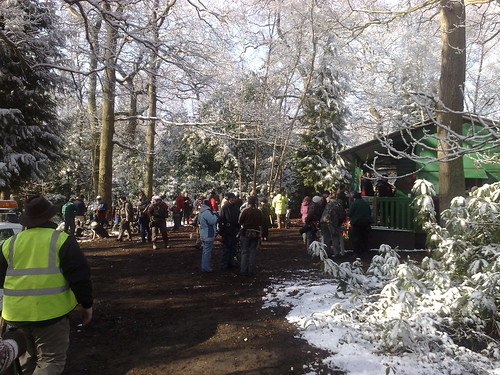
Everyone arriving and getting ready to start
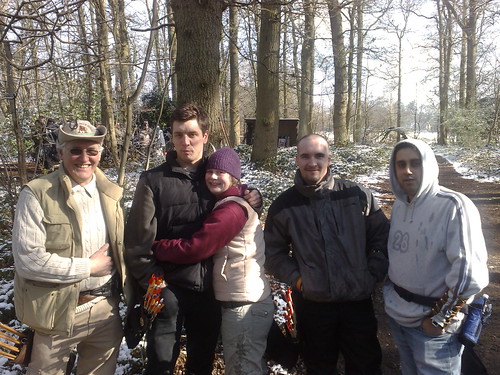
Us lot 🙂

Me shooting and trying very hard not to fall in!
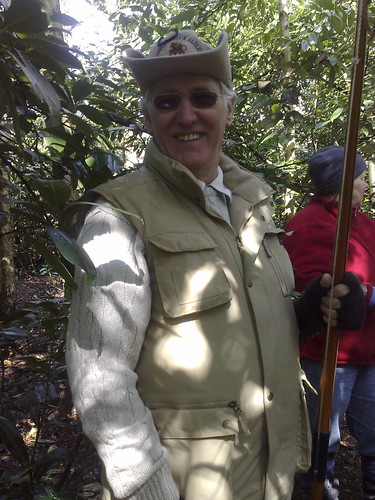
John always smiling!
It was a great day, and full credit to everyone from Severn Valley Yeoman’s for organising the shoot and setting up a very challenging but enjoyable course.
Student Lecture Notes infringe Professor’s Copyright?
Sounds almost surreal … taking notes in class is copyright infringement? I know this case is not that clear cut, the Professor is partnering with an e-book manufacturer and they’re trying to sue an organisation that pays students to take good notes which are then published. The whole thing seems to hinge on the notion that notes taken in class are “derivative works”
“Students are buying a particular note packet to do well on a particular exam by a particular professor,” Sullivan said. “The commercial appeal of the product is that it is a copy or close derivative work of that professor’s intellectual property.”
But if a professor’s lectures are copyrighted, aren’t students already infringing just by taking the notes in the first place?
Yes, Sullivan answers, student notes do infringe, but they are protected infringement.
“That’s absolutely fair use,” Sullivan said.
What if a student took notes, but didn’t copy anything verbatim from a professor’s lecture, and then decided to publish the notes online or sell them?
“While that may not be slavish copy, the notes would be a derivative work and a copyright holder has the exclusive right to create derivative notes,” Sullivan said.
Whilst I recognise that this is an attempt to protect the intellectual property of the Professor, and the whole business around paying students to make good notes which are then published so lazy students who dont go to class can benefit from them is of course ethically and morally questionnable … but it seems to me that this lawsuit has wider implications … for example:
How long will it be before students will have to sign an EULA before walking into a class room? Maybe I just don’t get it but this feels so wrong.
Stephen Hawking: Asks questions about the universe
A wonderful talk in which Stephen discusses the following questions:
- Where did we come from?
- How did the universe come into being?
- Are we alone in the universe?
- Is there alien life out there?
- What is the future of the human race
It’s an enlightening talk and makes me realise just how small we really are.
Death
        Death

Nor dread nor hope attend
A dying animal;
A man awaits his end
Dreading and hoping all;
Many times he died,
Many times rose again.
A great man in his pride
Confronting murderous men
Casts derision upon
Supersession of breath;
He knows death to the bone
Man has created death.

    -- by William Butler Yeats
So far 2008 has been a horrible year … another friend died last night … I’m struggling to focus at the moment, my thoughts feel increasingly morbid. Maybe I’m just having a bad day.
Data Portability
Here’s Talis’ very own Danny Ayers performing his song on Data Portability called “Get Your Data Out”
For those who don’t know what Danny is referring to The DataPortability movement is about ensuring the data you put into sites like Facebook or LinkedIn etc about yourself and your friends or contacts is available for you to move around between sites. This is still early days though and lot more work needs to be done before this becomes a reality but it’s encouraging that Facebook has agreed to work with the group and develop some standards.
They flee from Me
         They Flee from Me

They flee from me that sometime did me seek
With naked foot stalking in my chamber.
I have seen them gentle tame and meek
That now are wild and do not remember
That sometime they put themselves in danger
To take bread at my hand; and now they range
Busily seeking with a continual change.

Thanked be fortune, it hath been otherwise
Twenty times better; but once in special,
In thin array after a pleasant guise,
When her loose gown from her shoulders did fall,
And she me caught in her arms long and small;
And therewithal sweetly did me kiss,
And softly said, Dear heart, how like you this?

It was no dream, I lay broad waking.
But all is turned thorough my gentleness
Into a strange fashion of forsaking;
And I have leave to go of her goodness
And she also to use newfangleness.
But since that I so kindely am served,
I would fain know what she hath deserved.

              -- by Thomas Wyatt
Making Tea and the Semantic Web
Abstract. Making Tea is a design elicitation method developed specifically to
deal with situations in which (1) the designers do not share domain or artefact
knowledge with design-domain experts, (2) the processes in the space are semi-
structured and (3) the processes to be modeled can last for periods exceeding
the availability of most ethnographers. We propose a set of criteria in order to
understand why Making Tea worked. Through this criteria we also reflect upon
the relation of Making Tea to other design elicitation methods in order to pro-
pose a kind of method framework from which other designers may be assisted
in choosing elicitation methods and in developing new methods.
Download paper here, by Monica Schraefel and Alan Dix.
I periodically check up on Alan’s homepage at Lancaster University and have a read through any papers he has made available. Earlier today I found an interesting looking paper entitled: Within Bounds and Between Domains: Reflecting on Making Tea within the Context of Design Elicitation Methods – the abstract for which I have transcribed above.
Just reading the title made me smile as I recalled many an evening spent listening to Alan talking to me about an idea, or helping me understand something I was struggling with, all over a cup of tea (actually usually over several cups of tea!). I wasn’t sure what to expect from this paper, but I’m glad I read it, it proved invaluable for a number of reasons but primarily because it actually led me back to the Semantic Web, and some of the work we are doing at Talis. Whilst on the face of it this assertion might sound somewhat tenuous but maybe it isn’t … as I’ll try to illustrate briefly(ish)…
The paper describes some of the history behind an attempt by a group of computer scientists to design a digital version of a synthetic chemists lab book. However because the computer scientists were not experts in the domain or had very little experience in chemistry they struggled to understand the process that the chemists followed. Whilst they could observe the chemists doing their job and glean some information through interviewing them they simply could not understand the critical issue with reference to the lab books – when, how and why certain things were recorded and others were not. If your trying to create a digital replacement it’s absolutely imperative that you can understand what it is the user is doing and why. It’s at this point that Making Tea became so important …
In frustration, among the team of Canadian and British computer scientists and
chemists, the group made tea, a process embraced by both nations for restoring the
soul. It was at this point that the chemist-turned-software-engineer on the team said
“Making tea is much like doing an experiment.†The rest is history. The design team
took up the observation and used making tea to model the process of both carrying
out an experiment and recording it. To wit, the team’s chemist make tea multiple
times: first using well understood kitchen implements, where questions were asked
like “why did you not record that?†“You just did 20 steps to get the tea ready to pour,
yet you’ve only written down “reflux.†Why?†From kitchen implements, the team
moved to chemistry apparatus set up in the team’s design space. From there the team
moved to the chemistry lab. The results of the exchanges in these spaces informed the
design process. Indeed, they also informed the validation process: design reviews with
chemists in various positions, from researchers to managers to supervisors, were car-
ried out by making tea, and demonstrating how the artefact worked in the tea-making
experimental process. This time it was the chemists’ turn to interrupt the presentation
with questions about the artefact and their process.
The paper goes on to describe why ‘Making Tea’ worked so well as a design elicitation/validation method. I won’t provide a summary comparing it to other methodologies (you can read the paper for that) but I will summarise the four criteria that Monica and Alan identified that made it so successful in this example.
- Neutral Territory: Making Tea created a neutral space that was not owned by either the system designers or the domain experts – the intended users of the application. In a smiliar vain (although not exactly the same) having a neutral space you can go to to carry out design elicitation activities has proven hugely beneficial in our own experience at Talis. I have seen that removing ourselves from our offices or normal environment to spend time as part of a multi disciplinary team to focus on understanding and designing a solution to a problem both helps to focus us and place everyone on an equal footing in an alien environment. It also forces us to come together … thats important.
- Boundary Representation: When the problem domain is understood by both designers and users this forms a point of contact or reference that both groups feel comfortable with, and can relate to each other – it not only offered a way for domain experts to describe their tasks and activities, but also one where software engineers could offer back potential new designs
- Disruption: By being similar yet different from the actual process being represented, Making Tea forced the users to reflect on their tacit activities. To my mind this should be simple to appreciate for anyone who has ever pair programmed. When you constantly have someone asking you what your doing, asking you to talk through your thought processes, as disruptive as it might seem it actually forces you to reflect on what your doing. I’ve lost count of the number of times I’ll start to explain a piece of code I’m writing to someone, and then find that the actual processes of having to articulate what I’m doing reveals very quickly that I’m doing something wrong or failing to see the bigger picture.
- Time Compression: Making Tea reduced the time taken for a normal ex-
periment into a period that could be completed in a participatory session.The net effect of this is at facilitates rapid iteration of both observation of processes and each design. This sits quite well with the Agile mantra of rapid iteration and constant feedback.
I guess I like Making Tea, this entire metaphor feels very comfortable. It also got me thinking about some of the work I’ve been doing at Talis. I’ve been spending a fair amount of time looking at ontologies to represent different kinds of knowledge. Most recently Rob and I have been looking at how to model Workflow’s in RDF … it doesn’t sound particularly tea-like yet I can’t help but think that our current efforts to try and get closer to our users and also others working in this domain is going to help us understand what we are trying to build far better than trying to be purely academic in our approach to researching this area.
Now back to the tenuous Semantic Web link I mentioned earlier. Monica is working at Southampton University on a number of their semantic web projects. She was/is the Project Lead on MyTea, which tried to re-imagine the original work that the Smart Tea Project team mentioned in the paper did in building a digital lab book. What the MyTea project attempted to do was enhance the original work by integrating the tool with Semantic Technologies and what the folks down in Southampton refer to as The Semantic Grid ( they also run an active project called myGrid which appears to bring all this together ):
The Semantic Web and Semantic Grid, however, are motivating a possible sea change in the way scientists make their work available. With the Semantic Grid, a Web-based technology for sharing data and computation, scientists can share information in richer forms than traditional lab books and publishing has allowed. They will be able to make rafts of data generated in experiments available to other scientists, and to the public for compariosn exploration and study; they can share analyses of information and collaborate in new ways.
Now I’m not sure what the current status of either of the projects is since the paper was originally written in 2005, and the sites don’t look like they have been updated in a while other than myGrid. from my perspective im interested in the work flow modelling they talk about. Yet in additon to that there is something that does touch on what we are trying to do at Talis in building a platform that facilitates this notion of a Web of Linked Data – how to find ways of enriching existing applications by providing the means to link data together in ways that have never really been possible before. We have already seen the amazing things we can do with data and applications when you fundamentally accept that what we are talking about is not a technology change as such, but rather a complete paradigm shift.
This post does feel a bit strange due to the somewhat tenuous links and a bit of tangential reasoning but it’s forcing me to reflect on something I’m struggling to articulate at the moment … but that’s not a bad thing.
How Muslims are treated in the USA
A friend of mine sent me a link to this video wanting to know how it made me feel. So here goes. The video is a a show produced by ABC News. It shows that Islamaphobia is very real and exists within the US, but that is not all it shows. I found it to be extremely moving because the show highlights both deep prejudices as well as a deep sense of justice that many everyday Americans possess.
The show uses a scenario played out in a popular bakery by a pair of actors as a way to see how the members of the public witnessing what is happening react. One actor plays a young Muslim woman in a hijab, the other actor plays a bigoted store clerk who refuses to serve her based on the fact that she is a muslim, he proceeds to insult her with all sorts of derogatory anti-Muslim remarks.
It’s the reaction of members of the public that is both deeply disturbing but also leaves me with a sense of hope. The majority of the bystanders who witnessed the incident chose not to get involved – tacit support for the clerk?. A minority spoke up and defended the young lady, whilst others, sadly, got involved vocally and supported the store clerk.
For some reason watching this unfold reminded me of videos I had seen in my history class at school depicting the terrible kinds of segregation that existed in American during most of the last century. Also as someone who has spent a lot of time in South Africa it evokes memories of apartheid and recalling the first hand accounts of men and women who lived under that regime.
In this case though I was genuinely moved by the actions of those bystanders who spoke up in defense of the young lady, who saw and injustice and spoke out against it. That fills me with hope.
There’s two old maxim’s that always spring to mind when I think of these things:
         Evil is at its worst when it is practised
            by ordinary men and women.

         Evil thrives whilst good men and women
            stand by and do nothing.
I’m hopeful that over time things will change but I guess the challenge for Muslims is to somehow increase the ratio of the informed to the misinformed. Since ultimately this is about a lack of understanding. How do we do this though? When the mass media spends so much of its time demonising Islam, rather than explaining that the warped views of a minority are not shared by the vast majority of Muslims.
Nexuiz – Wonderful FPS
A couple of months ago our Development Team here at Talis decided they wanted to have some sort of game server running internally so we could have a little fun from time to time. Most people had settled on Unreal Tournament but it had two major problems, a) you needed a semi decent graphics card to play it, and b) you had to buy it ( if ur being honest and above board which we are! ).
 Anyway I came across Nexuiz, which is a free FPS based on an early Quake Engine. It requires fairly modest hardware to run, so it’s perfect for running on laptops. It also runs natively on both Windows and Mac which is excellent given a number of us have Mac Book Pro’s and I wasn’t sure if I wanted to try and run an FPS inside of VMWare although it would probably have worked. Anyway because of this we set up a Nexuiz Server running in a VM on our internal network. It runs very well, and plays incredibly well. It might not be as visually aesthetic as later versions of Quake or Doom or Enemy Territory, but what it lacks in visual polish it more than makes up for in playability … it is awesome!
Having played a few times there’s a number of things that strike me. I’ve been playing FPS games for a number of years, I even play for a great team. Now because Nexuiz is based on a Quake Engine, anyone who has ever played Quake/Doom/Enemy Territory will be immediately familiar with it. Whilst the game-play is different, as are the weapons, the damage levels and even the hit boxes, it doesn’t take too long to get used to it, or the frantic pace at which the game is played. Check out these gameplay videos…
It supports all the popular game modes, although at the moment we have it running Team Death Match pretty much all the time. it also supports a really nice little single player mode which is great to practise on, and get used to the controls and feel. I have to confess I am really beginning to like it, in a LAN setting. It’s a lot of fun, and just the thing when you need a five minute break from staring at a load of code that you have been refactoring for several hours.