Death and its poetry

On Thursday morning I ordered a bunch of books from Amazon. Lately I’ve started reading and in some cases re-reading texts related to the Samurai tradition, I’m not sure why other than I guess I need something to immerse myself in. Thursday afternoon I learnt that one of my uncles has passed away, so it was with mixed feelings I received a delivery from Amazon today containing, amongst other texts, a collection of Japanese Death Poems – in Zen they are often referred to as Parting of Life Verses since tradition has it that they composed by individuals on the verge of death. I’ve been reading a lot related to Zen lately and it’s not a secret that I have a bit of an obsession with haiku and also tanka. I am amazed to think of the presence of mind needed to compose the kind of verses I’ve been reading as the last thing these men and women did before succumbing to death.

It feel’s inadequate to describe these verses as beautiful in fact I can’t think of any adjective that does them justice. As I read some of them, I found that they forced me to reflect on recent events in my life, particularly the death of my father, I’m reminded of the pain that I feel and that I know I have been hiding from (something a friend at Talis forced me to confront on Thursday afternoon when he gave up part of his afternoon to see if I was ok, and to whom I am grateful).

As much as it hurts to think about it I find that I’m smiling, my father used to say that no-one could really choose the time of their passing, that it was inevitable and we should not fear it, but what we should do is make the most of the time we have and try to be the very best that we can.

He did and He was.

… and that’s a comforting thought 🙂 .

As for this collection of verses, as deeply profound as they all, one that captivated me the most so far was written by a woman, Oroku:

And had my days been longer               Nagaraete
still the darkness                        kono yo no yami wa
would not leave this world-               yomo hareji
along death's path, among the hills       shide no yamaji no
I shall behold the moon.                  iza tsuki o min.

        -- Oroku

Free Dr Sami Al-Arian

I came across the case of Dr Sami Al-Arian earlier today when a friend of mine brought it to my attention. It sounds bizarre. He was arrested and tried under the Patriot Act for allegedly being involved with some Palestinian terrorist Groups (and I use that phrase loosely given that even the UN recently released a report stating that what is happening in Palestine is not terrorism but resistance to an illegal and brutal occupation) . However the six-month trial featured more than 80 witnesses and 400 transcripts of intercepted phone conversations and faxes. At the end of the prosecution’s case, Al-Arian’s attorneys, remarkably, rested without offering a defense. On December 6, 2005, after 13 days of deliberations, the jury acquitted him on eight of 17 counts, while remaining deadlocked 10-2 in favor of acquittal on the other nine. Of fifty-one charges against the four men, not one resulted in a conviction. In other words he should have been acquitted since he wasn’t found guilty on any one of the charges. Yet he is still being held behind bars.

 "There is a pattern in the United States of taking out this type of
  extrajudicial punishment against people who refuse to be convicted ... 
  A jury was not going to give them what they wanted, and they would 
  have to take it some other way. And that's what they're doing right 
  now. They're giving out punishment to a man they couldn't convict"

    -- Jonathon Turley, member Al-Arian's legal team 
       and specialist national and security issues.

"To be patriotic is to be able to question government policy 
 in times of crisis. To be patriotic is to stand up for the bill of 
 rights and the Constitution in times of uncertainty and insecurity. 
 To be patriotic is to speak up against the powerful in defense of
 the weak and the voiceless. To be patriotic is to challenge the 
 abuses of the PATRIOT Act."

                Dr Sami Al-Arian

You can find out more about the case at http://www.usavsalarian.com and also at http://www.freesamialarian.com

Ironically a number of people have been asking me recently, how I feel about the fact that I’m traveling to China in order to present at the WWW2008 conference and whether I feel guilty that by even attending the conference in China I’m somehow tacitly supporting a regime with a history of human rights violations … I responded rather facetiously “no more guilty than when I travel to the US“. It was a rather glib response yet the truth is that if the world’s Greatest Democracy continues to be criticised for it’s human rights abuses then what hope is there of convincing nations like China that they should change. It smacks of a certain hypocrisy that we are quick to point the finger at nations like China but are hesitant to do anything about our own culpability, when our nations here in the west behave in the same abhorrent manner … is it a case of the pot calling the kettle black:

In the past five years the administration has authorized torture 
and other abusive interrogation techniques, “disappeared” dozens 
of suspected terrorists into secretprisons, twisted domestic law to 
permit indefinite detention without charge of persons suspected of 
links to terrorism, and confined hundreds at Guantanamo Bay without 
charge while denying them information about the basis for their 
detention and meaningful opportunity to contest it. The administration 
has sought to exempt its  actions from court oversight.

  -- Human Rights Watch Report 2007 on the United States.  

Uesugi Kenshin

I’m currently reading Zen and the Samurai which is a beautifully written work, much of it is devoted to anecdotes about the lives many famous Samurai and how Zen deeply influenced them. The book makes reference to the beautiful verse below which was composed by the Samurai General Uesugi Kenshin on his death bed. It was a practise amongst many Samurai to write a verse in either Chinese or Japanese at the moment of death, this was Kenshin’s Parting of Life Verse:

Even a life-long prosperity is but one cup of sake;
A life of forty-nine years is passed in a dream;
I know not what life is, nor death.
Year in year out-all but a dream.
Both Heaven and Hell are left behind;
I stand in the moonlit dawn,
Free from clouds of attachment.

… exquisite.

Video on flickr

Yay! finally we can upload and share our video’s on flickr. You can read about the new service over on the flickr blog

Here’s a funny video posted up by the flickr dev team:

Only Pro members can upload video’s and they can only be 90 seconds long which I actually find quite appealing as they explain on the Video FAQ:

Video on Flickr grew out of the idea of “long photos” and as such, we’ve implemented what might seem like an arbitrary limit of playing back the first 90 seconds of a video. 90 seconds?

We’re not trying to limit your artistic freedom, we’re trying something new. Everyone has endured that wedding video, where even the bride will fast-forward to the “good bit.”

I think its great 🙂

The Life Giving Sword

  Weapons are instruments of ill omen. The Way of Heaven
  finds them repugnant. The Way of Heaven is to use them
  only when necessary.

Finally finished reading The Life Giving Sword by Yagyu Munenori last night. The version I have is translated into English by William Scott and is and absolutely wonderful read. It is considered to be one of the most important and influential texts on Japanese Martial Arts. Scott’s introduction, which is a third of the book, is essential reading and provides, in great detail, the historical context in which this book was written. He not only provides an insight into the life of Munenori but also into life in Japan almost four hundred years ago.

It was also nice to see, in Scott’s account, references to Miyamoto Musashi’s The Book of Five Rings – which to my mind is another seminal text on Japanese Swordsmanship. What’s amazing is that both these men were alive at the same time, and yet they never met. It’s widely acknowledged that Musashi coveted Munenori’s position as Official Swords Instructor to the Tokugawa Shogunate but was never able to gain it over his great rival.

What sets this text apart from others is that it combines the technical refinements of Shikage-Ryu with the philosophical and psychological insights of Zen Buddhism, which Munenori was greatly influenced by through his close friendship with the famous Zen priest Takuan Soho ( author of The Unfettered Mind ). In fact, having read some of Soho’s essays,  I’m convinced that this Buddhist spirituality is reflected in the whole idea of the "life giving sword" – this notion that you can control an opponent through your own spiritual readiness to fight. It is further reflected in Munenori’s mastery of restraint and diplomacy through which he became a trusted advisor to the Shoganate – and whilst this might surprise some it really is an insight into the most personal thoughts on non-attachment and non-violence of one of the greatest of all master swordsmen.

It is missing the point to think that the martial arts is
solely in cutting a man down. It is not in cutting people down;
it is in killing evil. It is in the stratagem of killing the
evil of one man and giving life to ten thousand...truly the sword
that kills one man will be the blade that gives others life.

or …

In Zen there is a saying, "Beat the grass and scare up the snake".
Just as you beat the grass to scare up the snake that lies within,
there is a technique of suprising your opponent to cause his mind
to become agitated. Deception is doing something unexpected by your
opponent, and suprising him. This is the martial arts.

Once surprised, your opponent's mind will be taken, and his skill
undone. Raising your fan or hand in front of him will also take your
opponent's mind. Tossing aside the sword you are carrying is also a
martial art. If you have obtained the skill of No-Sword, what will
a sword be to you? 

Whilst his words can seem cryptic and inpenetrable at times there is no doubting Munenori’s immense skill as a swordsman, and yet apart from one instance there is no recorded account of him ever killing another in a duel. That one incident though is legendary,and remembered to this day:

... a desperate force of about twenty to thirty men ... broke into
the Shogun Tokugawa Hidetada's camp. The Shogun's men were thrown
into confusion as the assailants, almost incredibly, pressed their
way to within a short distance of the shogun himself. There, however,
they confronted a middle-aged samurai, who was standing calmly in front
of the shogun's horse. The man stepped forward and, with shocking speed,
dexterity, and grace, killed seven of the attackers, giving the shogun's
guards a chance to regroup ... the middle aged samurai was Yagyu Tajima
no kami Munenori.

I often find it interesting to contrast the lives of Musashi and Munenori, the former’s fame was gained through numerous duels and was regarded as an outstanding swordsman having killed so many, and the latter maintained an aire of invincibility without ever having fought a duel. It seems paradoxical. For some odd reason this reminds me of something Plutarch once wrote when he compared the Lives of Numa and Lycurgus

Virtue rendered the one so respectable to deserve a throne, 
and other so great as to be above it.

I know it doesn’t quite fit but it certainly resonates. I thoroughly recommend this book, it’s deeply philosophical and deeply profound and will change your understanding of the nature of any martial art.

p.s. and no I guess it’s not a coincidence that my new sword arrived the other day 🙂

JQuery: Dmitri Gaskin – yes he’s only 12

Dmitri Gaskin drinks code with his cereal for breakfast every morning. He’s a jQuery whiz and a Drupal know-it-all. He contributes patches for both Open Source projects. In the Drupal world, he maintains many modules, is on the security team, and is involved in the upcoming Summer of Code as a mentor and administrator. Dmitri has given many talks on Drupal and jQuery, in such places as Logitech, Drupalcon and live on a radio show out of L.A. When Dmitri isn’t coding, a very rare occurrence, he is playing and composing contemporary music. And attending classes in the 6th
grade. (He’s only 12.)

… a truly amazing individual and a wonderful presentation on jQuery.

A Farewell to False Love

      A Farewell to False Love

Farewell false love, the oracle of lies, 
A mortal foe and enemy to rest, 
An envious boy, from whom all cares arise, 
A bastard vile, a beast with rage possessed, 
A way of error, a temple full of treason, 
In all effects contrary unto reason. 

A poisoned serpent covered all with flowers, 
Mother of sighs, and murderer of repose, 
A sea of sorrows whence are drawn such showers 
As moisture lend to every grief that grows; 
A school of guile, a net of deep deceit, 
A gilded hook that holds a poisoned bait. 

A fortress foiled, which reason did defend, 
A siren song, a fever of the mind, 
A maze wherein affection finds no end, 
A raging cloud that runs before the wind, 
A substance like the shadow of the sun, 
A goal of grief for which the wisest run. 

A quenchless fire, a nurse of trembling fear, 
A path that leads to peril and mishap, 
A true retreat of sorrow and despair, 
An idle boy that sleeps in pleasure's lap, 
A deep mistrust of that which certain seems, 
A hope of that which reason doubtful deems. 

Sith* then thy trains my younger years betrayed, 
And for my faith ingratitude I find; 
And sith repentance hath my wrongs bewrayed, 
Whose course was ever contrary to kind:
False love, desire, and beauty frail, adieu. 
Dead is the root whence all these fancies grew. 

                  --Sir Walter Raleigh

Archery: Severn Valley

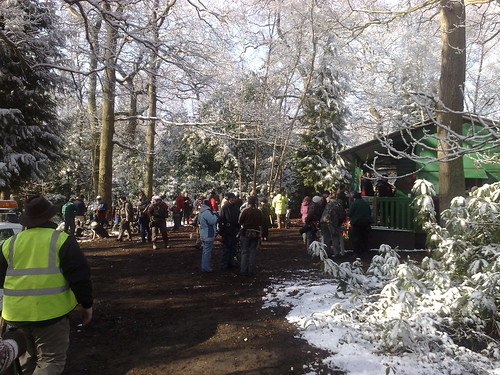
Had a wonderful day shooting in Severn Valley yesterday. It was 36 target shoot with a 10:30am start, we finished around 3pm. What made this shoot different was that due to heavy snowfall the forest was covered in snow before we began, during the course of the day this did melt away but we did have a couple of rather sudden blizzards to contend with as we went round the course.

Not only was it very cold the ground was also incredibly muddy so I found that I was walking around rather gingerly in case I lost my footing and fell down a hill again. The turnout on the day was exceptional given the bad weather. We were represented by Richard, Alex, John, Simon, Cliff and myself – we had to split into pairs so I spent the day shooting with John.

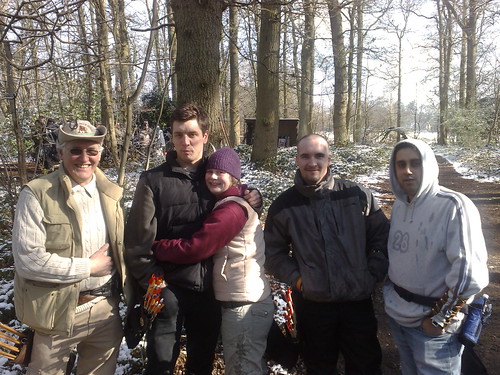
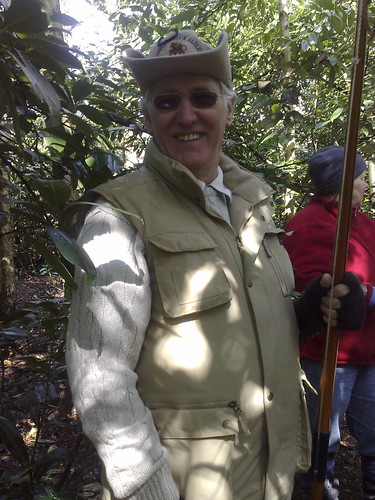
It was not one of my better performances … I shot well below my usual par but this didn’t change the fact that we all had immense fun. Richard and I both forgot to pack our camera’s so I took some pictures with my mobile fun which have been uploaded to my flickr account, and here’s a couple of my favorites from the day:


Everyone arriving and getting ready to start


Us lot 🙂


Me shooting and trying very hard not to fall in!


John always smiling!

It was a great day, and full credit to everyone from Severn Valley Yeoman’s for organising the shoot and setting up a very challenging but enjoyable course.

Student Lecture Notes infringe Professor’s Copyright?


Sounds almost surreal
… taking notes in class is copyright infringement? I know this case is not that clear cut, the Professor is partnering with an e-book manufacturer and they’re trying to sue an organisation that pays students to take good notes which are then published. The whole thing seems to hinge on the notion that notes taken in class are “derivative works”

“Students are buying a particular note packet to do well on a particular exam by a particular professor,” Sullivan said. “The commercial appeal of the product is that it is a copy or close derivative work of that professor’s intellectual property.”
But if a professor’s lectures are copyrighted, aren’t students already infringing just by taking the notes in the first place?
Yes, Sullivan answers, student notes do infringe, but they are protected infringement.
“That’s absolutely fair use,” Sullivan said.

What if a student took notes, but didn’t copy anything verbatim from a professor’s lecture, and then decided to publish the notes online or sell them?

“While that may not be slavish copy, the notes would be a derivative work and a copyright holder has the exclusive right to create derivative notes,” Sullivan said.

Whilst I recognise that this is an attempt to protect the intellectual property of the Professor, and the whole business around paying students to make good notes which are then published so lazy students who dont go to class can benefit from them is of course ethically and morally questionnable … but it seems to me that this lawsuit has wider implications … for example:

How long will it be before students will have to sign an EULA before walking into a class room? Maybe I just don’t get it but this feels so wrong.